



The last issue left a question open. Cleveland’s rent spread is real but stubbornly local — it doesn’t follow a tidy “build here, rents fall” rule — and the East Side corridor itself posts only modest rent growth: Hough up 3.2%, Fairfax barely above zero, all middling within the metro. So why single the corridor out at all?
Because the corridor is the one place in Cleveland where the demand side of the equation is being deliberately, and visibly, rebuilt — and that is what eventually moves rent and value, on a longer clock than a single year’s survey. The most useful idea in this market right now is that not all supply behaves the same way. Supply that arrives on its own competes for a fixed pool of renters and pushes rent down. Supply that arrives with jobs, infrastructure, and institutional capital behind it expands the pool faster than it fills. The East Side is being built as the second kind, and three converging initiatives are the reason.
The Jobs Engine
Demand is what makes new housing absorb rather than dilute.
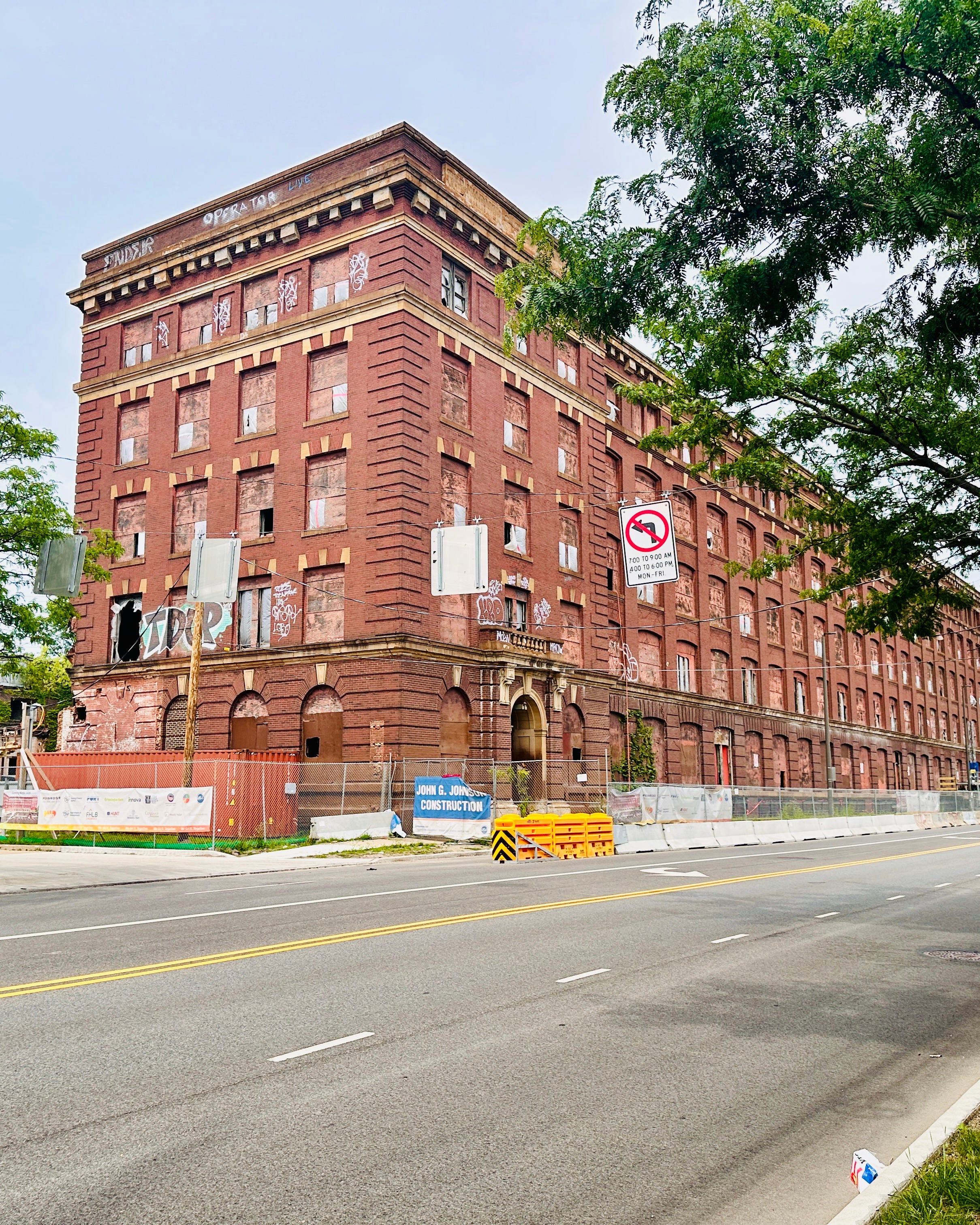
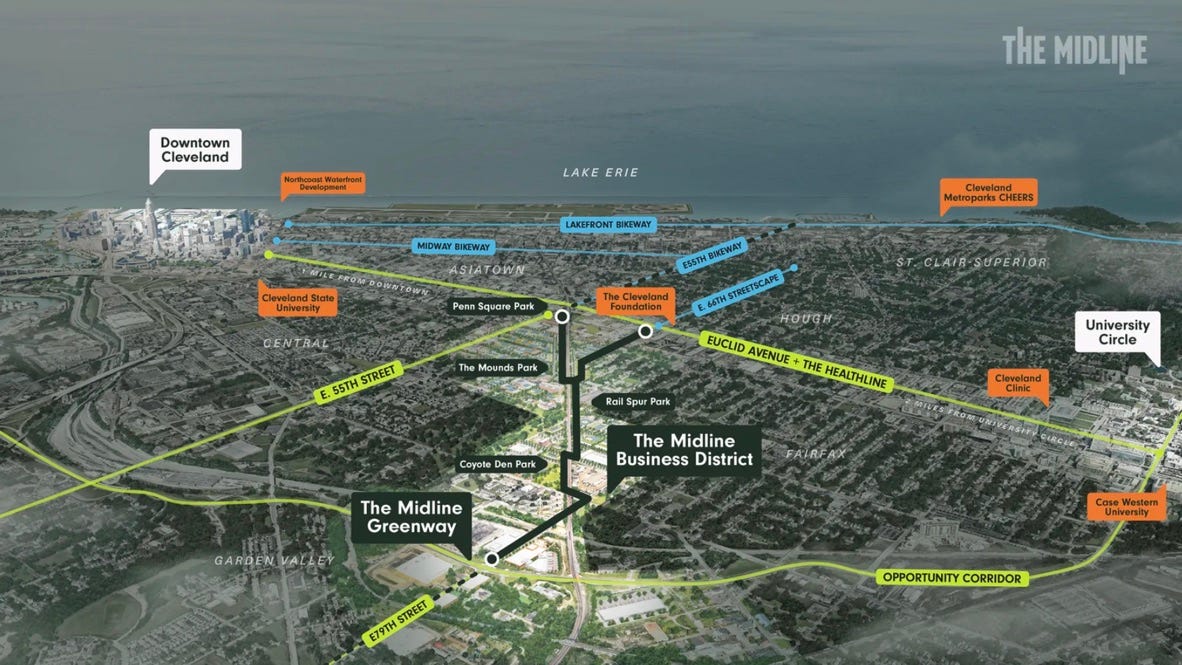
Start with demand, because demand is what fills units. The Cleveland Midline is the largest industrial redevelopment in the city’s history — roughly 350 acres of long-vacant land along the Norfolk Southern rail corridor on the near East Side, being assembled into an employment district and public greenway. The projected scale is the part that matters for housing: at full build-out, more than 1.5 million square feet of new industrial and commercial space, on the order of 2,500 jobs, and up to $100 million in annual tax revenue. Crucially, the site sits within a thirty-minute commute of nearly 900,000 workers — a labor shed, not a residential radius, which is the right way to read a jobs play.
And the jobs are not hypothetical. A Cleveland Clinic laboratory and research complex is planned at the corridor’s “Yellow Brick Road” site, and the area’s existing food-production cluster — Orlando Baking, Nor-Am Cold Storage, and Miceli Dairy, which has signaled plans to expand — is growing rather than leaving. The district is being designed for advanced manufacturing, biomedical, and R&D uses, and explicitly not for low-employment uses like distribution or data centers. That distinction is the whole thesis: this is supply that arrives carrying wages.
A multifamily owner does not underwrite a greenway. But a multifamily owner absolutely underwrites a few thousand jobs landing within a short commute of their building, because that is the demand that fills units and supports rent. The Midline is being funded the way durable demand usually is — a coalition of public, philanthropic, and private capital, anchored by a site-readiness fund rather than a single speculative developer betting on a cycle.
The Policy Engine
Policy explains why the new supply can be built cheaply and fast enough to arrive at all.
In June, Cleveland City Council approved a Housing Innovation District over Hough, Central, and St. Clair-Superior — historically redlined neighborhoods where poverty rates run from roughly four in ten residents to, in Central, nearly seven in ten.
The mechanics are aimed squarely at the cost and friction of building. The district halves multifamily permitting and waives permit fees for new single-family construction. A form-based rezoning replaces a cumbersome code with one that allows duplexes, bungalows, and mixed-use repurposing of vacant buildings. A thirty-year tax-increment-financing district covering some 1,500 acres would, by the city’s own estimate, generate between $90 million and $245 million over three decades — reinvested not into a single building but into the streets, sidewalks, parks, and utilities that make a neighborhood absorb growth.
There is a structural reason this kind of intervention is needed here. In these neighborhoods, what a finished home is worth on completion often falls short of what it costs to build — so the math doesn’t close, and private capital alone hasn’t rebuilt these blocks for decades. That gap is exactly what the subsidy, the fee waivers, and the infrastructure spending are meant to bridge. The policy is not a giveaway; it is filling a cost-to-value gap that has frozen development, not subsidizing a market that would otherwise function.
Housing Joined to Industrial Policy
Most cities run housing and jobs on separate desks. Cleveland is sequencing them together.
What makes Cleveland unusual is that these are not running as separate programs. The mayor’s office frames the corridor explicitly as housing policy joined to industrial policy — deliberately sequencing where people will work with where they will live. Most cities treat housing supply as a thing to permit and jobs as a thing to recruit, on separate timelines and separate desks. Pairing them is what turns new supply from a rent headwind into a rent tailwind, and it is the structural reason the East Side is moving against the metro number.
What Could Break This
A transaction analysis that pretended this was settled would be worth less.
None of this is finished, and most of it is early. The risks are real and worth naming plainly.
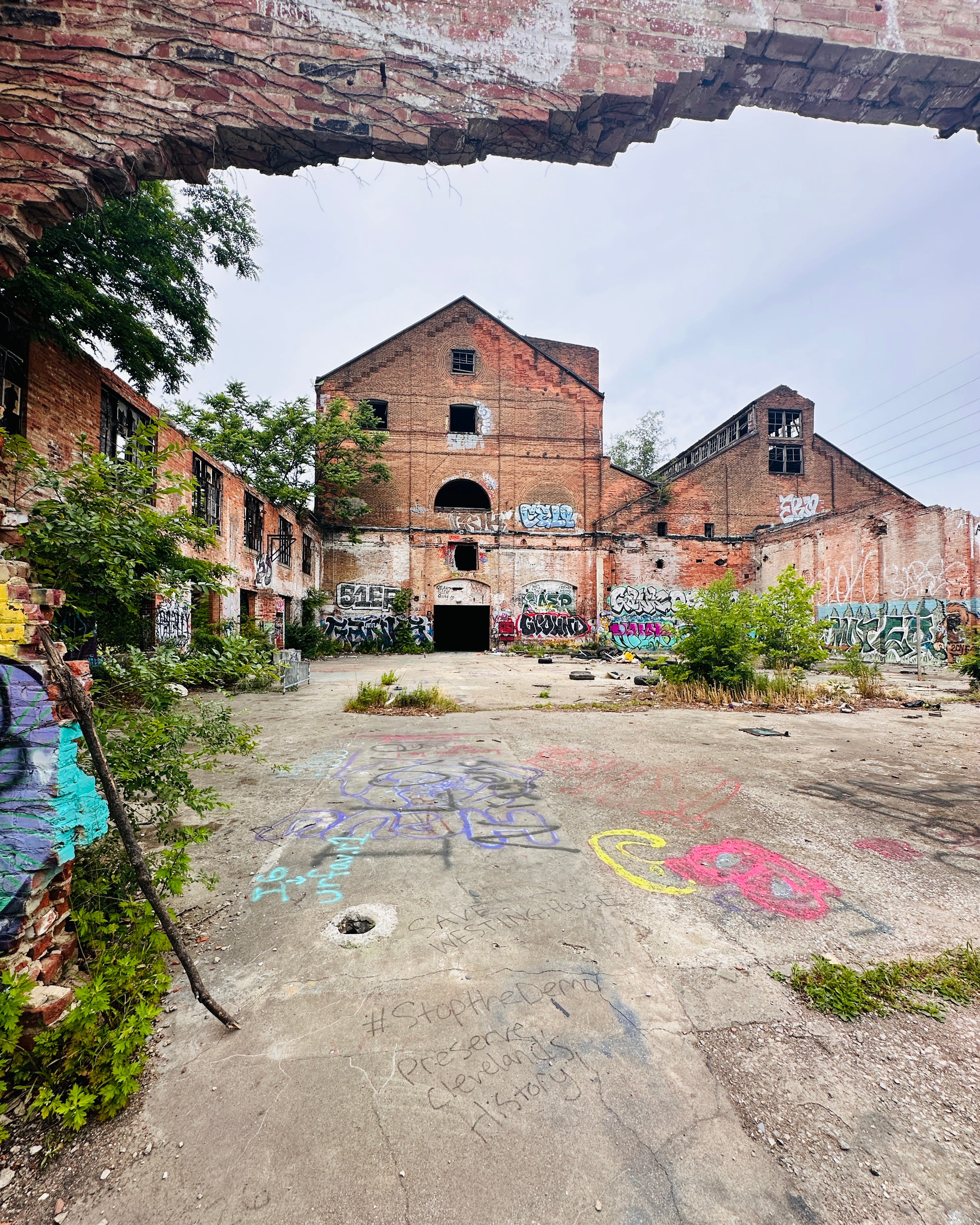
Displacement. The same plan that promises investment has drawn the predictable concern. At a May council hearing, a resident asked directly why she should be displaced “just so you can come in and make money.” The city’s answer is arithmetic — more than 2,800 vacant lots inside the district, which it frames as room to add without subtracting — backed by land trusts, set-aside repair dollars for existing homeowners, and permanent-affordability mechanisms. Those tools are real but unproven at this scale.
The politics aren’t unanimous. At least one council member publicly doubted the philanthropic structure behind the housing pilots, warning it could weaken the community development organizations that have held these blocks together. Capital convergence creates value; it does not guarantee the value reaches the residents the policy names.
It’s early, and it’s leveraged. Authorizing legislation was still moving through Council as the plans firmed; the Midline’s master plan and much of its remediation funding remain to be finalized; and the Cleveland Clinic lab, while reported, has not been formally confirmed at a fixed scale. Brownfield cleanup on this land is expensive and chronically underfunded. These are reasons the corridor is a forward case measured in years, not a finished one — which is precisely why the rent data shows modest current numbers against a strengthening demand picture.
For an owner, the analytical takeaway survives either outcome. The near East Side is the rare corner of Cleveland where supply, demand, and public capital are moving in the same direction at the same time — which is precisely the condition under which a property's value firms rather than erodes. Whether a specific property is positioned to benefit depends on where it sits in the corridor, what its contract rents look like against a strengthening submarket, and how its basis compares to recent arm’s-length sales. Those are property-level questions the published averages cannot answer — and they are exactly the questions an owner should be asking now, while the demand picture is still forming and the basis still reflects the old story rather than the new one.
The full corridor analysis — the comp set and the pipeline mapped against where the public investment is landing — is coming in the MarketRent™ Cleveland report.
Own multifamily, land, or an underused asset on Cleveland's East Side? The metro average won't tell you what it's worth in a market this uneven — your submarket will. Clarendon Property Advisors advises owners on affordable and conventional multifamily, land, and repositioning. Request a confidential asset evaluation →
Pulse — What We're Tracking
Trump halts the bipartisan housing bill (Axios, June 24) — The 21st Century Road to Housing Act — which passed both chambers overwhelmingly and would boost supply and cap private-equity single-family buying — is in limbo after the President canceled the signing pending an unrelated voting bill. It isn’t dead (it can become law without his signature once transmitted), but the delay injects fresh federal uncertainty into an already cautious market.
Rent control’s national fight hits a wall in Massachusetts (Bisnow, June 23) — Massachusetts’ high court struck the nation’s most aggressive statewide rent-control measure from the November ballot on a technicality — one front in a fight now running from California to the Northeast. For owners, it’s a reminder that regulatory risk, not just rates, is shaping where capital will and won’t commit; proponents call the flaw “easily fixable” and plan to refile.
Harvard’s State of the Nation’s Housing 2026 (JCHS) — The field’s annual benchmark on affordability, supply, and cost burdens is out — essential context for where the affordable thesis sits nationally as deliveries crest and funding shifts.
Also Tracking
Apartment rents edge higher in June (CoStar) — a subdued spring leasing season nationally, against which Cleveland’s submarket spread stands out
What $1,500 rents across U.S. markets (RentCafe) — the affordability gradient in one comparable, a useful frame for Midwest value

Tools • Services • Archive • About • Contact
About: Clarendon is a trusted partner for government compliance and advisory solutions, specializing in HUD-compliant services: brokerage, appraisals, rent comparability studies, market studies, inspections, facility support and strategic guidance for agencies, housing authorities and property owners nationwide.
© 2026 The Clarendon Group, Inc. All Rights Reserved. Disclosure
The cost-to-value gap point is the one every owner in that corridor should be reading twice.