


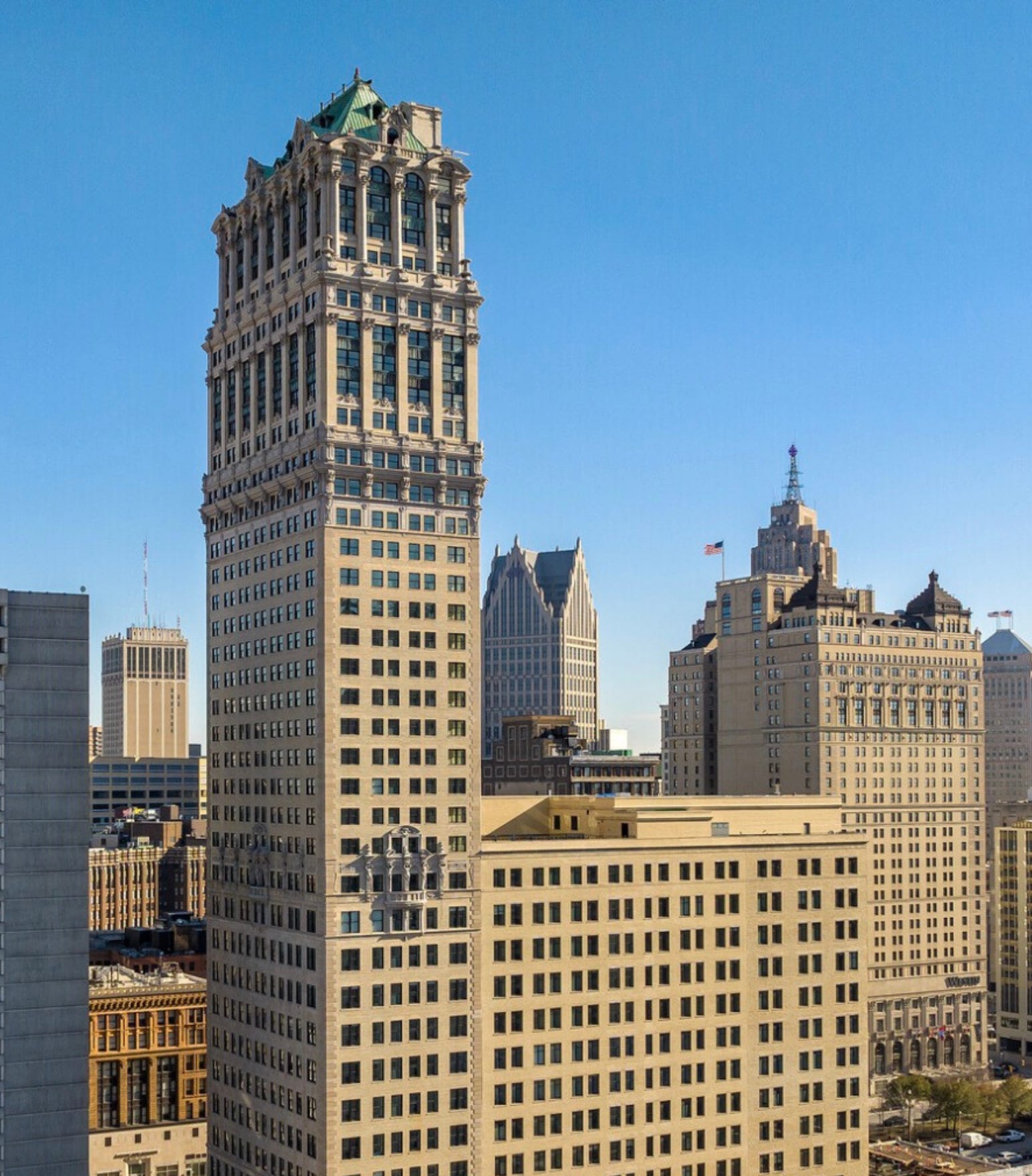
Detroit has authored one of the most closely watched urban turnaround stories in the country. Ranked 78th among the world’s top 100 cities in Resonance’s 2025 World’s Best Cities Report, the Motor City now draws attention for its affordability, cultural investment, and expanding economic base — a position few observers would have predicted a decade ago. For multifamily owners and investors holding assets in this market, that transformation carries direct implications for property performance.
The most current market data provides a precise picture of where Detroit stands today — and where the opportunity landscape is developing.
Downtown Detroit: Adaptive Reuse as a Market Driver
The defining story of downtown Detroit’s revival is the conversion of underutilized office towers and historic commercial buildings into multifamily housing. Former office inventory — available at acquisition costs that created the economic conditions for large-scale residential conversion — has been reimagined into apartments, coworking spaces, and cultural destinations. The concentration of projects across downtown has produced mixed-use neighborhoods with genuine live-work-play density.


Flagship conversions illustrate the scale and character of this transformation. The Book Tower at 1265 Washington Boulevard — a $317 million restoration by Bedrock — delivered 229 residential units alongside hospitality, restaurant, and retail space in one of Detroit’s most recognizable pre-war skyscrapers after decades of vacancy. The Free Press Building at 321 W. Lafayette, also by Bedrock at $69 million, preserved the Art Deco murals and limestone carvings of the former Detroit Free Press headquarters while converting it into 105 apartments with ground-floor retail. Gabriel Houze at 305 Michigan Avenue — the former Archdiocese of Detroit headquarters, converted by Barbat Holdings for $17 million — demonstrates that adaptive reuse in Detroit operates across a wide range of investment scales, delivering 112 one-bedroom units with views of both the Detroit and Windsor skylines.
Community spaces like Monroe Street Midway demonstrate how thoughtful placemaking can transform vacant lots into vital community assets. Detroit’s commitment to walkability — wide sidewalks, bike lanes, and improved public transit — has enhanced connectivity, making downtown one of the most accessible urban centers in the Midwest.
Detroit has also prioritized inclusive economic growth, implementing policies that support minority entrepreneurship, equitable housing access, and workforce development. The adaptive reuse of buildings has created diverse residential options accommodating a range of income levels — a dynamic that benefits long-term residents as well as new arrivals and sustains demand for workforce and affordable housing alongside market-rate development.
Midtown Detroit: The City’s Most Promising Multifamily Hub
While downtown attracts the most visible conversion projects, Midtown has emerged as the metro’s most strategically positioned multifamily submarket. Once defined by economic struggles, the district has transformed into a vibrant, highly sought-after neighborhood anchored by institutional infrastructure that sustains renter demand year-round.


The presence of Wayne State University, the Detroit Institute of Arts, and Henry Ford Health System has cemented Midtown as an intellectual and cultural hub. These institutions attract a steady flow of students, professionals, and visitors, creating sustained demand for housing. The Plaza at 3800 Woodward Avenue — a $20 million conversion by Roxbury Group delivering 72 units in a former office tower directly on the QLine corridor — anchors the submarket's completed residential stock, while Brush Watson at 444 Watson Street in Brush Park, a $45 million mixed-use development by American Community Developers delivering 300 mixed-income apartments, represents the scale of investment now moving through the pipeline.
A key element of Midtown’s appeal is its walkability. The ongoing development of the Woodward Avenue M-1 Light Rail links Midtown to other key areas of Detroit — a major draw for investors who recognize that modern renters prioritize convenience and mobility. Midtown’s transformation has been fueled by targeted investments and public-private partnerships promoting adaptive reuse and new construction, with the pipeline now including 609 units under construction and 923 units in planned projects awaiting approval.
Multifamily Market Performance
According to Yardi Matrix Q1 data, the Detroit metro rents grew 1.6% year-over-year as of March 2026, ranking 55th nationally among 141 tracked markets and improving nine positions from the prior period. Lifestyle properties (Class A/B+) advanced 1.8%, while Renters-by-Necessity (RBN) properties — the B through D asset classes serving renters for whom renting is an economic necessity rather than a lifestyle choice, and the segment most directly comparable to Project-Based Section 8 housing — climbed 1.6%.
Detroit’s submarket spread tells the real story. The strongest performers — St. Clair Shores/Grosse Pointe (11.1% rent growth, $1,457/month, 94.8% occupancy), Detroit-south (6.1%), Wayne/Romulus (4.8%, $1,151/month, 95% occupancy), Belleville (3.9%, $1,332/month), and Warren (3.6%, $1,126/month) — share a common profile: limited new supply, proximity to employment corridors, and steady demand from workforce renters.
Downtown Detroit’s average rents reached $1,626/month with 92% occupancy, but year-over-year growth stands at just 0.8% as the submarket works through a supply cycle — Lifestyle inventory grew 39% over the past five years, adding more than 1,100 units, and one-bedroom rents declined 0.6% year-over-year. No new completions are projected for Downtown in 2026, supporting gradual stabilization as absorption catches up.
Midtown presents a more nuanced picture. Average rents are $1,438/month with 92.3% occupancy and 1.0% overall rent growth. The Lifestyle tier is performing meaningfully better, however — averaging $1,581/month with 3.1% growth, making Midtown the third-ranked Lifestyle submarket in the metro. The supply pipeline is measured: just 69 units are projected for completion in 2026, representing 0.8% inventory growth, positioning the submarket for continued stabilization supported by its institutional demand base.
The Economic Foundation
Detroit’s economy has diversified well beyond its automotive roots, anchored by a healthcare and education cluster that rivals any peer city in the Midwest. Education and Health Services — the sector that encompasses Wayne State University, Henry Ford Health System, and the Detroit Medical Center — added 2,600 jobs year-over-year, growing to represent 16.3% of the metro’s 2.074 million non-farm workers. Government employment also expanded, adding 3,100 positions at 1.6% growth. These are the sectors whose workers rent in Midtown and across Detroit’s workforce housing market, and their stability provides a demand floor that sustains occupancy even when broader market conditions moderate.
Detroit has also positioned itself at the forefront of innovation, cultivating specialized districts focused on mobility, life sciences, and urban technology. As healthcare, technology, and infrastructure investment continue to compound, Detroit’s economy is positioned for steady, long-term growth supported by institutional anchors that are not easily replicated in other markets.
Ready to go deeper on this market? Clarendon provides HUD Rent Comparability Studies, market studies, brokerage, and advisory services across major U.S. markets. To discuss your portfolio, visit clarendon.com/how-can-we-help.
What’s in the Full Market Brief


The Detroit Market Brief includes detailed office-to-residential conversion profiles for Downtown and Midtown Detroit properties, a deep dive into the Midtown development pipeline and multifamily metrics. Access the full brief in the Market Reports section.
Policy Watch
HUD published revised FY 2026 Fair Market Rents (FR Doc. 2026-07741, effective May 21, 2026), updating FMRs for seven metropolitan areas based on new PHA survey data. Most Midwest and Northeast markets are unaffected. The notice also includes HUD’s responses to 21 public comments on FMR methodology — covering the ACS data lag, the mandatory SAFMR program, and the reevaluation burden on PHAs — with direct implications for Section 8 renewal strategy.
Related Resources
Explore office-to-residential conversions and the downtown and midtown development pipeline on the MarketRent™ interactive map. For the full FY 2026 revised FMR notice, see Federal Register Doc. 2026-07741 (91 FR 21301), effective May 21, 2026. For SAFMR data by ZIP code, visit the HUD FY 2026 SAFMR Lookup Tool.

Podcast • Tools • Services • Archive • About • Contact
About: Clarendon is a trusted partner for government compliance and advisory solutions, specializing in HUD-compliant services: HUD RCS, appraisals, brokerage, inspections, facility support and strategic guidance for agencies, housing authorities and property owners nationwide.
© 2026 The Clarendon Group, Inc. All Rights Reserved. Disclosure