



Detroit ranks 78th in the 2025 Resonance World’s 100 Best Cities Report — ahead of several U.S. peer cities and recognized for its combination of affordability, cultural depth, and expanding economic horizons. The recognition reflects a transformation that has been building through deliberate strategy, not a single catalyst.
The Motor City’s downtown has been reimagined through adaptive reuse of historic buildings, mixed-use development, and investments in walkability and public space. Former office towers and industrial sites are now modern apartments, coworking spaces, and cultural destinations. Year-to-date rent growth in the Detroit Metro stands at 3.0%, outpacing the national average, with growth projected to reach 4.4% in 2025 as absorption strengthens, according to CoStar.
Two distinct stories are playing out in parallel: Downtown Detroit, where a significant concentration of new Class A inventory is working through absorption, and Midtown Detroit, where institutional anchors and pedestrian-friendly infrastructure are driving some of the city’s strongest multifamily fundamentals.
The Flagship Conversion
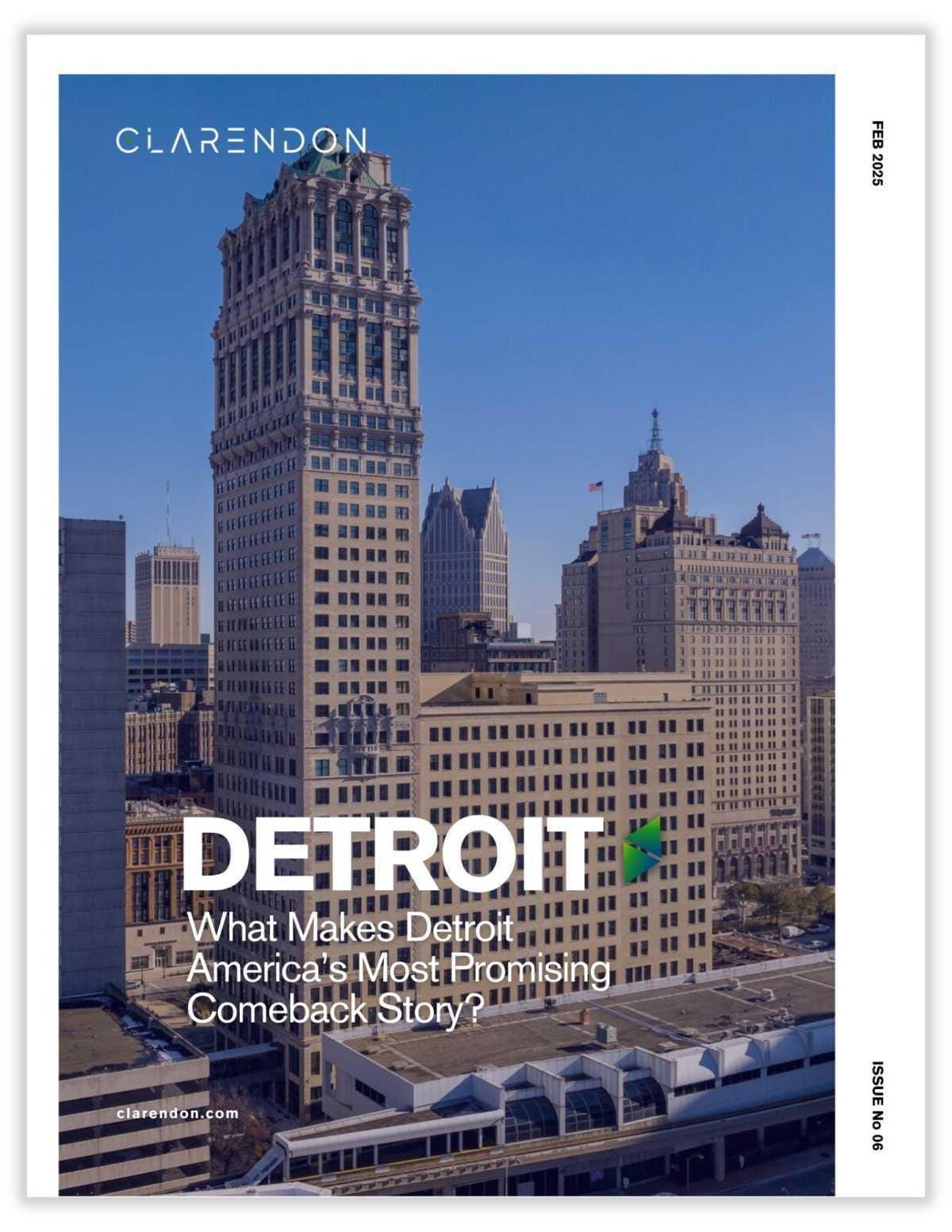
1265 Washington Boulevard — the Book Building and Tower, one of Detroit’s most iconic skyscrapers — anchors the downtown conversion story. Originally constructed in 1917 with a tower added in 1927, the building sat vacant for decades before Bedrock undertook a 317 million dollar historic restoration. The revitalized Book Tower now features 229 residential units, the ROOST Book Tower extended-stay hospitality concept, 85,000 square feet of retail and office space, two restaurants, a hotel lobby bar and lounge, and a rooftop event space. Construction was completed in 2023.
The broader downtown pipeline spans multiple decades of architecture and investment. At 7430 2nd Avenue in Midtown, the Albert Kahn Building — a 330,727 square foot Class four-star structure built in 1931 — was converted by The Platform into 206 residential units at a cost of 58 million dollars, completed in 2021. At 305 Michigan Avenue, Gabriel Houze offers 112 rental units in a 10-story 1940 building that formerly served as Archdiocese of Detroit headquarters, developed by Barbat Holdings for 17 million dollars, completed in 2020. At 321 West Lafayette Boulevard, the former Detroit Free Press building — a 12-story Art Deco landmark built in 1925 — was converted by Bedrock into 105 apartments with ground-floor retail and office space at a cost of 69 million dollars, completed in 2020.
Why Now
Detroit’s adaptive reuse momentum reflects a city that has made deliberate bets on its architectural heritage. Affordable acquisition costs for historic buildings, combined with targeted public-private partnerships and preservation incentives, have made conversions financially viable and structurally compelling.
Midtown has emerged as the city’s most promising multifamily hub, anchored by Wayne State University, the Detroit Institute of Arts, and Henry Ford Health. These institutions create sustained demand for housing and drive rental occupancy rates among the highest in the city. The ongoing development of the Woodward Avenue M-1 Light Rail enhances connectivity, linking Midtown to other key areas of the city and strengthening the neighborhood’s appeal to renters who prioritize mobility.
Ford’s Corktown Campus, bringing 5,000 jobs to a neighborhood adjacent to downtown, is expanding Detroit’s employment geography beyond its traditional corporate core. The broader economy is diversifying through Smart Zones that foster collaboration among universities, government, and private industry in mobility, life sciences, and urban technology. Manufacturing remains Detroit’s dominant sector with 253,000 jobs and a location quotient of 1.5, while construction and natural resources lead overall employment growth at 5.65%.
The Multifamily Metrics
Detroit Metro rent growth of 3.0% year-to-date outpaces the national average of 0.9%, with average market rents at 1,329 dollars per month, according to CoStar. Mid-tier three-star properties lead the metro at 3.2% growth with average rents of 1,405 dollars per month. One- and two-star affordable units post the strongest growth at 3.6%, averaging 1,072 dollars per month, driven by sustained demand for workforce housing. Four- and five-star luxury units show more modest growth at 1.4%, with average rents of 2,018 dollars per month, as elevated vacancy in recently delivered supply tempers performance.
Downtown Detroit’s rent picture is more nuanced, with overall year-to-date growth at negative 1.0% and average rents of 1,670 dollars per month. The four- and five-star segment saw a negative 2.0% decline, reflecting the challenge of absorbing a significant volume of new Class A inventory. Mid-tier units fared better at 0.2% growth. Downtown vacancy stands at 16.4%, the highest of any submarket profiled — though forecasts project a decline to 14.5% by 2026 as absorption catches up with supply.
Midtown Detroit tells a more stable story. Overall rent growth of 0.8% year-to-date reflects the submarket’s steady institutional demand base. Three-star properties posted 1.3% growth, and one- and two-star units grew by 1.4%. Midtown vacancy of 10.7% is meaningfully below Downtown’s rate, sustained by Wayne State University and the Detroit Medical Center driving consistent leasing activity.
Detroit Metro’s overall vacancy of 7.3% year-to-date remains below the national average of 8.1%, reflecting relative market stability despite supply-side pressure. Metro construction activity stands at just 1.04% of inventory — well below the national average of 3.23% — as developers exercise caution in response to elevated downtown vacancy. This moderated pipeline creates conditions for gradual stabilization as existing supply is absorbed.
Ready to go deeper on this market? Clarendon provides HUD Rent Comparability Studies, market studies, brokerage, and advisory services across major U.S. markets. To discuss your portfolio, visit clarendon.com/how-can-we-help
Explore the Conversion Projects
MarketRent™ tracks office-to-residential conversion projects across nine major U.S. cities. The interactive map includes individual property profiles with developer, unit count, construction status, and development cost for each project.
Explore the Interactive Conversion Map — Detroit and 8 Cities
Members can access the full interactive map at marketrent.us — search and filter projects across Detroit, Cleveland, New York, Boston, Pittsburgh, Philadelphia, Washington DC, Los Angeles, and Cincinnati.
What’s in the Full Market Brief

The MarketRent™ Market Brief on Detroit covers the office-to-residential conversion projects reshaping Downtown and Midtown — with individual property profiles including developer, unit count, construction status, and development cost — alongside rent growth and vacancy rate analysis across the US, Detroit Metro, Downtown Detroit, and Midtown Detroit submarkets, new supply and absorption data, and a review of the economic drivers shaping the Detroit market, including the Midtown institutional anchor ecosystem and Ford’s Corktown expansion.
The full brief is available to MarketRent™ members at marketrent.us.
Access the Detroit Market Brief → www.marketrent.us
Related Resources
For more on office-to-residential conversion trends across U.S. markets, see NYC Financial District: A New Era for Downtown Manhattan, Pittsburgh: The Golden Triangle Converts, Cleveland: Urban Revival and the Adaptive Reuse Opportunity, and Mapping the Shift: Where Offices Are Becoming Homes.

Podcast • Tools • Services • Archive • About • Contact
About: Clarendon is a trusted partner for government compliance and advisory solutions, specializing in HUD-compliant services: HUD RCS, appraisals, brokerage, inspections, facility support and strategic guidance for agencies, housing authorities and property owners nationwide.
© 2026 The Clarendon Group, Inc. All Rights Reserved. Disclosure