



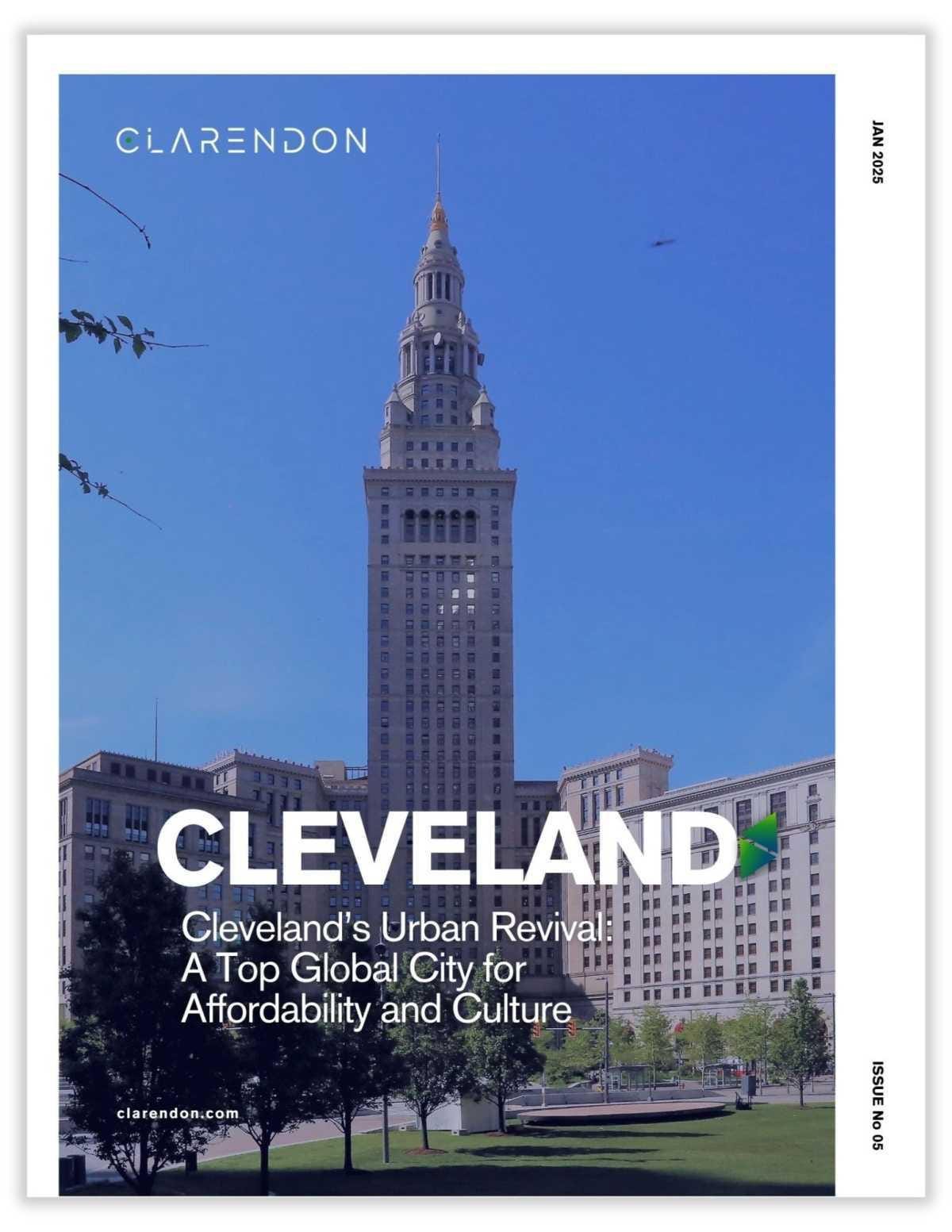
Cleveland has been ranked among the world’s top cities — placing 70th globally, ahead of Hong Kong, Rio de Janeiro, and Athens. The recognition reflects a market transformation that has been years in the making, not a sudden pandemic-era pivot.
While other cities scrambled to address post-2020 office vacancy, Cleveland was already converting. Affordable acquisition costs for aging office buildings, a deep inventory of historic structures, and a sustained commitment to adaptive reuse have positioned Downtown Cleveland as one of the more active office-to-residential markets in the Midwest. Year-to-date rent growth in the Cleveland Metro stands at 2.9% — more than three times the national average of 0.9%, according to CoStar.
The transformation extends well beyond downtown’s conversion pipeline. A 330 million dollar infrastructure investment is unlocking development potential across long-neglected neighborhoods, connecting institutional anchors to the city’s residential core and creating conditions for durable, long-term multifamily performance.
The Flagship Conversion
50 Public Square — the Terminal Tower, a 1.1 million square foot landmark built in 1930 — anchors Cleveland’s adaptive reuse story. Purchased in 2016 for 38.5 million dollars, the building was converted by K&D Group into a mixed-use development comprising 297 one- and two-bedroom apartments alongside office space on the upper floors. Development cost: 80 million dollars. Construction was completed in 2019. The project preserved the tower’s architectural history while introducing modern residential amenities to one of Downtown’s most prominent addresses.
Terminal Tower is not an isolated project. The broader Downtown Cleveland conversion pipeline includes 200 Euclid Avenue — the former May Building, a 972,573 square foot structure converted by Bedrock into 307 apartments at a cost of 165 million dollars, completed in 2020. At 1965 East 6th Street, the Garfield Building was repositioned into 123 residential units, with its former banking hall transformed into the Marble Room restaurant, completed in 2017. At 75 Public Square, a 144,471 square foot building built in 1913 was converted into 114 apartments by Millenia Companies at a cost of 43 million dollars, completed in 2022.
Why Now
Cleveland’s adaptive reuse approach reflects strategic planning, not reactive repositioning. The city’s architectural inventory — pre-war office towers and industrial buildings with manageable floor plates and strong bones — is well-suited for residential conversion. Affordable acquisition costs have made the economics viable where they would not be in higher-cost coastal markets.
The Opportunity Corridor adds a second dimension to this market story. Completed in November 2021 at a cost of 330 million dollars, the 3.2-mile roadway links University Circle with Interstate 490, running through the Fairfax, Kinsman, and Slavic Village neighborhoods. The corridor was designed as an urban boulevard rather than a limited-access highway, preserving all cross-street connections and integrating pedestrian and bicycle infrastructure. The result is a catalyst for mixed-income housing and commercial development in neighborhoods that had been largely bypassed by prior investment cycles.
The Sherwin-Williams headquarters expansion — a 600 million dollar project adding a 1 million square foot headquarters and research facility to Downtown Cleveland — is expected to generate 8.6 million dollars in annual tax revenue and retain 3,500 jobs. Healthcare continues to anchor the broader economy: employment in education and health services is growing at 2.88%, outpacing the national average, driven by Cleveland Clinic and University Hospitals. The Health-Tech Corridor links Downtown to University Circle across a 1,600-acre zone that houses more than 170 health-tech companies, incubators, and academic institutions.
The Multifamily Metrics
Cleveland Metro rent growth of 2.9% year-to-date outpaces the national average of 0.9% by a substantial margin, with growth projected to accelerate to 5.1% as new supply tapers and demand stabilizes, according to CoStar. Average rents in the metro stand at 1,216 dollars per month, with meaningful differentiation across building classes.
Mid-tier three-star properties lead performance in the Cleveland Metro, posting 3.1% rent growth year-to-date with average rents of 1,244 dollars per month. One- and two-star affordable units follow closely at 3.5% growth, averaging 892 dollars per month — reflecting persistent demand for workforce housing. Four- and five-star luxury units show more moderate growth at 1.7%, with average rents of 1,868 dollars per month, as elevated vacancy in newly delivered luxury stock tempers performance.
In Downtown Cleveland specifically, rent growth is more restrained at 0.9% year-to-date, with average rents of 1,688 dollars per month. The four- and five-star segment maintains a 34% premium over three-star properties but faces vacancy headwinds from new luxury deliveries. Downtown vacancy stands at 14.5% year-to-date — elevated but consistent with a market absorbing a significant conversion pipeline, with luxury vacancy at 16.0%, three-star at 12.3%, and one- and two-star at 10.8%.
The East Cleveland submarket, which encompasses the Opportunity Corridor, posts 2.8% rent growth — mirroring broader metro trends — with vacancy at 13%. Affordable and mid-tier properties perform more steadily in this submarket, driven by sustained demand for lower-cost housing options. Cleveland Metro’s overall vacancy rate of 8.2% modestly exceeds the national average of 7.9%, reflecting the region’s ongoing absorption of new supply rather than fundamental demand weakness.
Cleveland’s construction pipeline has moderated to 2.2% of total inventory year-to-date, down from 2.64% in 2022 — below the national average of 3.51%. Downtown remains the most active submarket at 6.1% of inventory under construction, though well below the 15% peak of 2018. The easing pipeline creates conditions for improved absorption and rent performance as the current supply cycle matures.
Ready to go deeper on this market? Clarendon provides HUD Rent Comparability Studies, market studies, brokerage, and advisory services across major U.S. markets. To discuss your portfolio, visit clarendon.com/how-can-we-help
Explore the Conversion Projects
MarketRent™ tracks office-to-residential conversion projects across nine major U.S. cities. The interactive map includes individual property profiles with developer, unit count, construction status, and development cost for each project.
Explore the Interactive Conversion Map — Cleveland and 8 Cities
Members can access the full interactive map at marketrent.us — search and filter projects across Cleveland, New York, Boston, Detroit, Pittsburgh, Philadelphia, Washington DC, Los Angeles, and Cincinnati.
What’s in the Full Market Brief

The MarketRent™ Market Brief on Cleveland covers the office-to-residential conversion projects reshaping Downtown — with individual property profiles including developer, unit count, construction status, and development cost — alongside rent growth and vacancy rate analysis across the U.S., Cleveland Metro, Downtown Cleveland, and East Cleveland submarkets, new supply and absorption data, and a review of the economic drivers shaping the Cleveland market, including the Opportunity Corridor and major employer anchors.
The full brief is available to MarketRent™ members at marketrent.us.
Access the Cleveland Market Brief → www.marketrent.us
Related Resources
For more on office-to-residential conversion trends across U.S. markets, see NYC Financial District: A New Era for Downtown Manhattan, Pittsburgh: The Golden Triangle Converts, Cleveland: Urban Revival and the Adaptive Reuse Opportunity, and Mapping the Shift: Where Offices Are Becoming Homes.

Podcast • Tools • Services • Archive • About • Contact
About: Clarendon is a trusted partner for government compliance and advisory solutions, specializing in HUD-compliant services: HUD RCS, appraisals, brokerage, inspections, facility support and strategic guidance for agencies, housing authorities and property owners nationwide.
© 2026 The Clarendon Group, Inc. All Rights Reserved. Disclosure