



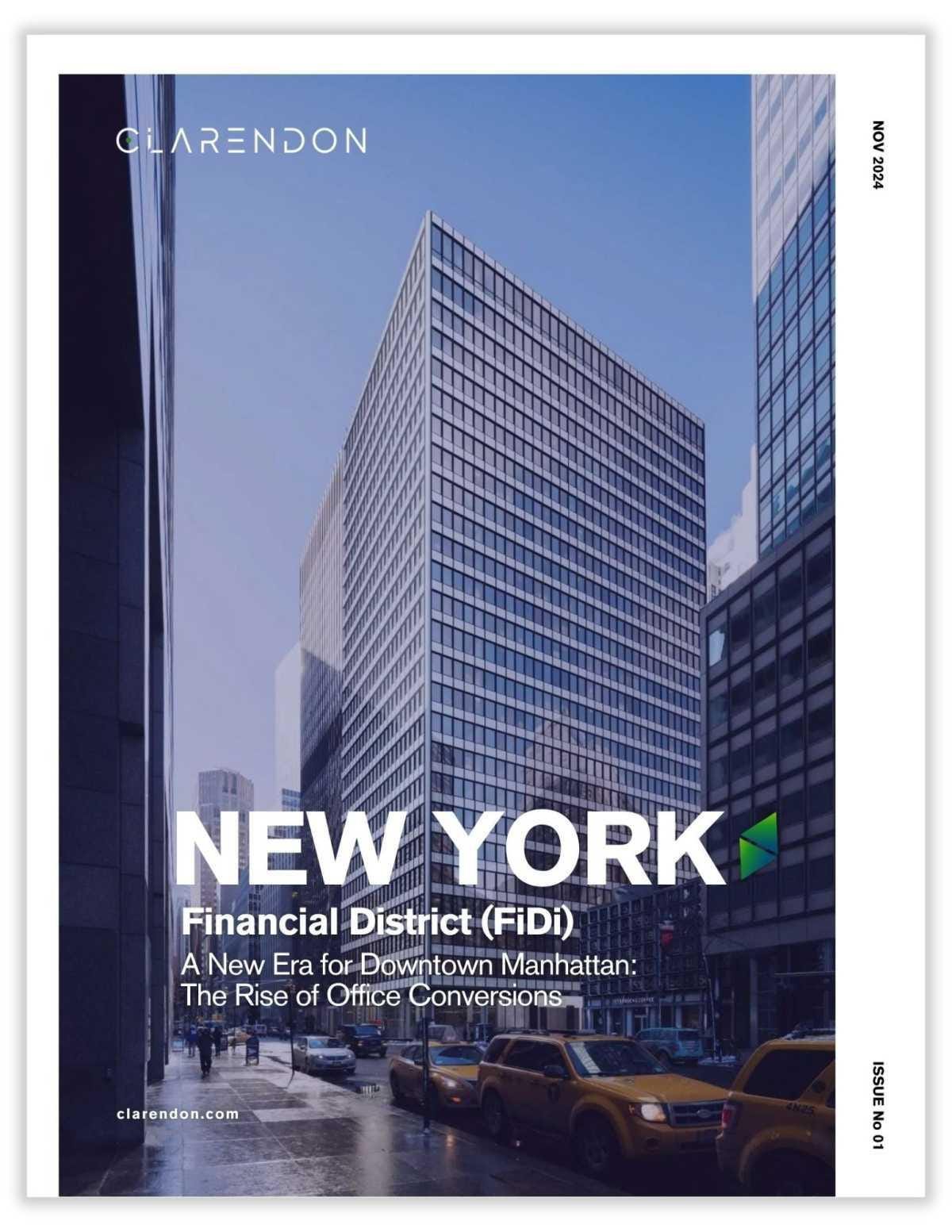
Manhattan’s Financial District has been converting office space to residential use since the 1990s. What’s underway now is different in scale and urgency.
Office availability across Manhattan reached 18.2% before declining to 17% — the largest single-quarter reduction in available space on record, according to CoStar. The mechanism driving that reduction isn’t tenant demand for offices. It’s residential conversion.
As tenant demand gravitates toward the highest-quality buildings, a substantial volume of vintage Manhattan office space is lying vacant. Sixty-four buildings had expressed interest in converting to residential use. FiDi alone has converted more than 22 million square feet since 1995 — and the current pipeline dwarfs everything that came before it.
The Flagship Project
25 Water Street — a 1.1 million square foot, 22-story tower built in 1968 — is converting to 1,300 residential units. It will be the largest office-to-residential conversion in U.S. history. Development cost: $540 million. Developers: GFP Real Estate, Metro Loft Management, and Rockwood Capital. Amenities will include pools, a basketball court, a sky lounge, and coworking spaces.
This is not an isolated transaction. Other active conversions in FiDi include 55 Broad Street, a 30-story 1967 tower converting to 571 units at a cost of $220 million, developed by Metro Loft and Silverstein Properties. At 85 Broad Street, 300,000 square feet is being repositioned for 600 new apartments.
Why Now
New York has done this before. The 421-g tax incentive program in the 1990s drove the first major conversion wave in lower Manhattan — significant property tax exemptions to developers, reduced vacancy rates, increased housing supply. The city is drawing on that playbook again: easing regulatory burdens, expanding conversion eligibility, and targeting vintage office stock that no longer competes for Class A tenants.
Pre-war buildings with smaller floor plates are ideal candidates. Their adaptable layouts support residential conversion in ways that large-plate modern towers do not. As these buildings are repositioned, FiDi is evolving into a more vibrant, mixed-use neighborhood — a transformation with implications for the entire submarket’s multifamily performance.
The Multifamily Metrics
New York Metro’s multifamily market continues to outperform most of the U.S., sustained by high demand and a structurally tight housing supply. Rent growth across all building classes came in at 1.9% year-to-date — more than double the national average of 0.9%, according to CoStar.
Within FiDi specifically, all building classes posted 3.2% rent growth year-to-date, with the average rent for all classes at $5,547 per month. The mid-tier three-star segment recorded the highest growth at 5.1%, with an average rent of $4,719 per month — consistent with the broader New York Metro pattern where mid-tier properties are outperforming luxury.
Vacancy in the New York Metro stands at 2.8% — among the tightest multifamily markets in the country, against a national average of 7.9%. FiDi’s vacancy rate of 3.5% reflects the incoming conversion supply: 25 Water Street alone is projected to push FiDi vacancy to 9.3% before demand absorption brings it back to 5.5% as supply is absorbed.
The supply picture is different in adjacent submarkets — Tribeca, SoHo, and Hudson Square — creating meaningful near-term differentiation in rent growth expectations across lower Manhattan.
Ready to go deeper on this market? Clarendon provides HUD Rent Comparability Studies, market studies, brokerage, and advisory services across major U.S. markets. To discuss your portfolio, visit clarendon.com/how-can-we-help
Explore the Conversion Projects
MarketRent™ tracks office-to-residential conversion projects across nine major U.S. cities. The interactive map includes individual property profiles with developer, unit count, construction status, and development cost for each project.
Explore the Interactive Conversion Map — New York and 8 Cities
Members can access the full interactive map at marketrent.us — search and filter projects across New York, Boston, Cleveland, Detroit, Pittsburgh, Philadelphia, Washington DC, Los Angeles, and Cincinnati.
What’s in the Full Market Brief

The MarketRent™ Market Brief on New York Financial District covers the office-to-residential conversion projects reshaping lower Manhattan — with individual property profiles including developer, unit count, construction status, and development cost — alongside rent growth and vacancy rate analysis across US, New York Metro, and Financial District submarkets, new supply and absorption data, and a review of the economic drivers shaping the New York Metro market.
The full brief is available to MarketRent™ members at marketrent.us.
Access the NYC Financial District Market Brief → www.marketrent.us
Related Resources
For more on office-to-residential conversion trends across U.S. markets, see NYC Financial District: A New Era for Downtown Manhattan, Pittsburgh: The Golden Triangle Converts, Cleveland: Urban Revival and the Adaptive Reuse Opportunity, and Mapping the Shift: Where Offices Are Becoming Homes.


Podcast • Tools • Services • Archive • About • Contact
About: Clarendon is a trusted partner for government compliance and advisory solutions, specializing in HUD-compliant services: HUD RCS, appraisals, brokerage, inspections, facility support and strategic guidance for agencies, housing authorities and property owners nationwide.
© 2026 The Clarendon Group, Inc. All Rights Reserved. Disclosure
