


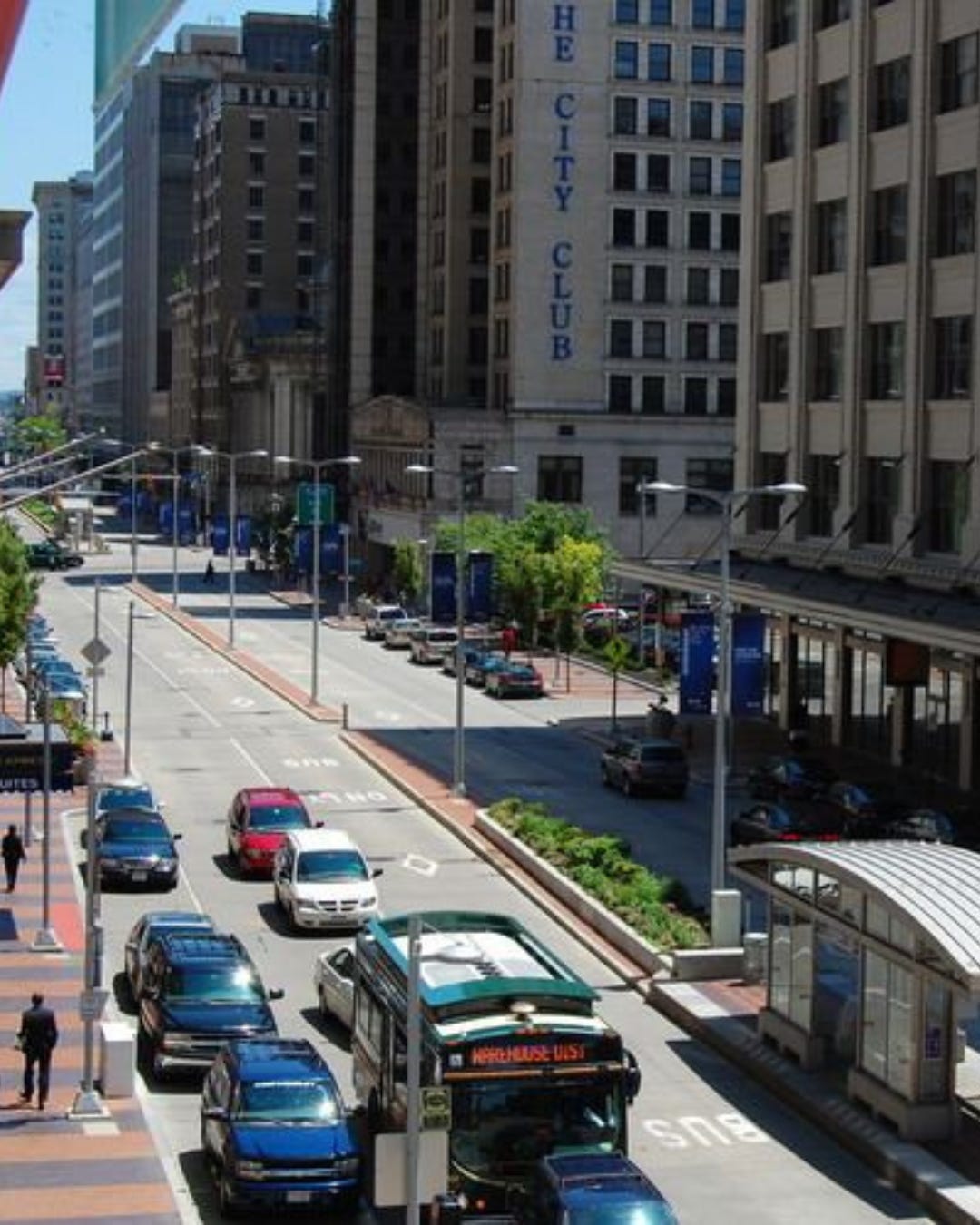
When the national conversation about office-to-residential conversion accelerated after the pandemic — driven by empty towers in Manhattan, San Francisco, and Washington DC — the framing was almost universally forward-looking. A new tool for a new problem. What that framing missed is that cities like Cleveland, Pittsburgh, Cincinnati, and Detroit had been doing this for decades, not out of post-pandemic strategy, but out of economic necessity. They converted buildings the market had abandoned. Now the coasts are doing the same thing — but for different reasons, with different economics, and with far less institutional experience behind them.
Cleveland passed through a phase that Boston and New York are just entering. That history matters for how you read the downtown submarket data today.
This is the second article in MarketRent™’s Cleveland series. The city-level overview — economic base, the Opportunity Corridor, Cleveland’s global recognition as one of the world’s best cities — was published in Cleveland’s Urban Revival: Market Intelligence for Real Estate Investors. This piece covers the downtown development story specifically: the pre-Covid leadership, the conversion pipeline, and what the market performance data shows for investors and owners evaluating downtown assets.
Fifty Years of Adaptive Reuse — Before It Was National Policy
Cleveland’s adaptive reuse history begins in the 1970s with the conversion of the 1924 Commodore Hotel into residential apartments — nearly a half-century before the term “adaptive reuse” entered the mainstream policy vocabulary. By the time the pandemic created the conditions for a national conversion wave, Cleveland had already completed thirty-six adaptive reuse projects delivering more than five thousand residential units, placing it eighth nationally in converted apartments and ahead of much larger cities including San Francisco, Dallas, and Washington DC.
Some of the earliest and most prolific conversion cities are not the ones you’d expect. Cleveland has about 38 projects, the vast majority already completed, making it one of the first cities to embrace adaptive reuse at scale. Detroit, Pittsburgh, and Cincinnati followed similar paths, converting vacant downtown office towers into housing years before the pandemic made it fashionable. These cities did it out of economic necessity, repurposing buildings that the market had abandoned. Now the coasts are doing the same thing — but for different reasons: their buildings aren’t abandoned, they’re just half-empty.
The economic logic was specific to Cleveland. Historic office buildings in the downtown core were available at acquisition prices that made residential conversion financially viable at rent levels the local market could actually support. Ohio’s historic preservation tax credit program — one of the most actively used state-level incentives in the country — provided the public subsidy that closed the gap between acquisition and renovation costs on buildings that otherwise would have sat vacant or been demolished. Tax credits for historic building preservation in Ohio have funded conversions in Cleveland and Cincinnati, alongside similar Rust Belt markets. That combination of affordable acquisition and available tax credit financing created the conditions for a conversion market that was self-sustaining well before the pandemic created urgency elsewhere.
The 1970s marked the beginning of residential adaptive reuse in Cleveland, with 198 new units created by repurposing the old 1924 Commodore Hotel. Since then, projects have increased in number. Following the national trend, Cleveland conversions culminated in the 2010s — out of its 36 adapted buildings, 20 were converted in the last decade alone, introducing a total of 2,778 new apartments to the city.
That acceleration through the 2010s — twenty of thirty-six buildings converted in a single decade — is the foundation on which the more visible recent projects were built. By the time Terminal Tower’s conversion delivered in 2019, Cleveland already had decades of institutional knowledge in adaptive reuse: contractors who understood historic building construction, architects experienced in floor plate reconfiguration, and a regulatory environment shaped by years of working through the practical challenges of converting buildings that were not designed for residential use.
The Pipeline That Remade the Skyline
The projects that define downtown Cleveland’s current residential character were mostly completed before the pandemic forced the rest of the country to take adaptive reuse seriously. They are not prologue. They are the established inventory that set the submarket’s rent and occupancy floor.

Terminal Tower — 50 Public Square The most recognizable project in the pipeline and the most visible signal of what adaptive reuse at scale looks like in practice. K&D Group acquired the city’s landmark 1926 tower and converted twelve floors into two hundred ninety-seven studio, one- and two-bedroom apartments, completing the project in 2019 at a development cost of eighty million dollars. The conversion retained office and retail uses on the lower floors, creating a genuine mixed-use building rather than a wholesale residential conversion. DLR Group reimagined Terminal Tower as a residential space featuring amenities including a rooftop deck with views of the Cleveland cityscape. Explore the Cleveland development map at marketrent.us.

May Building — 200 Euclid Avenue The largest adaptive reuse project in the downtown pipeline by unit count, delivering three hundred seven apartments at a development cost of one hundred sixty-five million dollars. The May Building anchors the Euclid Corridor — the spine of downtown Cleveland’s residential transformation — and its scale positioned it as the proof-of-concept for institutional-quality product drawn from historic office inventory. Its absorption through the lease-up period established market-level benchmarks for the entire corridor.

Schofield Building — 2000 East Ninth Street One of the earlier mixed-use hybrid conversions in the market, combining a Kimpton hotel on the lower floors with residential apartments above — a program that demonstrated adaptive reuse in Cleveland could support hospitality and residential uses simultaneously. The fifty-million-dollar renovation preserved the building’s ornate original exterior while delivering contemporary units, establishing the template for subsequent projects that combined historic preservation with modern residential programming.

Garfield Building — 1965 East Sixth Street Millenia Companies converted this downtown office building into one hundred twenty-three apartments with the original banking hall repurposed as the Marble Room restaurant — one of the more distinctive ground-floor activations in the portfolio. Rather than treating the historic banking hall as a liability to be minimized, the project leveraged it as a neighborhood amenity that generates independent foot traffic and reinforces the building’s residential identity. That model has influenced how subsequent conversion projects have approached ground-floor programming.

75 Public Square Millenia’s second downtown project, delivering one hundred fourteen apartments in a 1913 Class B building with a rooftop addition that expanded the building’s amenity offering beyond what the historic structure could provide on its own. The rooftop demonstrates that adaptive reuse can add net new amenity space — not merely preserve existing structure — and compete on the amenity dimension that drives leasing decisions in the current market.

The Collins and Triton at the Flats — Scranton Peninsula The most recent addition to the downtown pipeline represents a shift in project type — ground-up new construction on the Scranton Peninsula rather than historic conversion, but occupying the same downtown submarket and competing for the same renter. NRP Group completed The Collins, totaling three hundred sixteen units across two five-story buildings with a unit mix ranging from studios to three-bedrooms. Directly across from The Collins, J Roc Development completed Triton at the Flats, adding two hundred ninety-three units in early 2026. Together these two projects represent the largest single wave of new downtown supply in recent years — and their absorption progress is the primary variable shaping near-term submarket vacancy.
The full development pipeline — with project profiles, construction status, developer, unit mix, and map locations — is documented on the MarketRent™ interactive development map.
The Halle Building and the Longer Conversion Arc

The Halle Building is the project that best illustrates the depth of Cleveland’s pre-Covid conversion history. The historic restoration and adaptive reuse of the twelve-story, 323,000-square-foot Halle Building converted floors six through twelve into one hundred twenty-two luxury apartments, while the remaining lower floors feature office and retail space. The building was originally the Halle Brothers department store and is listed on the National Register of Historic Places. It was also, for a period, the fictional Winfred-Louder department store in The Drew Carey Show — a detail that captures something genuine about Cleveland’s relationship with its built history. These are not anonymous commercial buildings being repurposed. They are buildings with civic identity, and their conversion to residential use has preserved that identity while giving it new economic purpose.
The Halle Building conversion and projects like it through the 2010s created the institutional infrastructure that made the Terminal Tower and May Building projects feasible. Contractors, architects, lenders, and regulators in Cleveland have accumulated experience with adaptive reuse that simply does not exist at scale in markets that are entering this phase now. That institutional depth is part of what Cleveland offers as a conversion market — and why its downtown residential inventory has a character and permanence that ground-up luxury product in other markets cannot replicate. Explore the Cleveland development map at marketrent.us.
What the Downtown Submarket Data Shows
The pipeline context frames how to read the submarket performance data correctly. Downtown Cleveland’s vacancy is elevated relative to the metro — a direct consequence of absorbing a concentrated wave of new supply, including both the most recent conversion completions and the Scranton Peninsula ground-up projects. This is a supply absorption dynamic, not a demand failure.
The building class breakdown tells the nuanced story. Four- and five-star properties in the downtown submarket carry a meaningful premium over three-star inventory — a spread that has held through the delivery cycle and reflects genuine product differentiation. Luxury vacancy is the component most affected by the new supply wave, which is consistent with how absorption dynamics operate in any market following a concentrated delivery period. Mid-tier and workforce assets in the downtown submarket are performing substantially better than the headline vacancy number implies.
Concession levels are elevated in the downtown submarket relative to suburban submarkets with limited supply activity — another predictable feature of the absorption period that follows peak delivery. For investors, elevated concessions in a market with a contracting construction pipeline represent a temporary condition rather than a structural one. Construction starts have pulled back significantly, with rising costs and reduced new project underwriting activity limiting what enters the pipeline over the next several years. The supply pressure that is currently compressing downtown returns is not being extended by a subsequent wave.
Ready to go deeper on this market? Clarendon provides HUD Rent Comparability Studies, market studies, brokerage, and advisory services across major U.S. markets. To discuss your portfolio, visit clarendon.com/how-can-we-help.
What’s in the Full Market Brief


The MarketRent™ Cleveland Market Brief covers the downtown adaptive reuse pipeline in depth — with individual project profiles including developer, unit mix, development cost, and construction status — alongside rent growth and vacancy analysis across the United States, Cleveland Metro, Downtown Cleveland, and East Cleveland submarkets by building class, and a review of the economic and institutional drivers shaping the market’s long-term trajectory. Access the full brief in the Market Reports section.
For more on Cleveland’s broader market context, see Cleveland’s Urban Revival: Market Intelligence for Real Estate Investors. For context on the national adaptive reuse trend, see Mapping the Shift: Where Offices Are Becoming Homes and Downtown Pittsburgh: Building a New Future. Next in this series: development in Cleveland’s neighborhoods — the Opportunity Corridor, University Circle, and the East Side pipeline.
Related Resources
Explore office-to-residential conversions on the MarketRent™ interactive map. For SAFMR data by ZIP code, visit the HUD FY 2026 SAFMR Lookup Tool.

Podcast • Tools • Services • Archive • About • Contact
About: Clarendon is a trusted partner for government compliance and advisory solutions, specializing in HUD-compliant services: HUD RCS, appraisals, brokerage, inspections, facility support and strategic guidance for agencies, housing authorities and property owners nationwide.
© 2026 The Clarendon Group, Inc. All Rights Reserved. Disclosure