



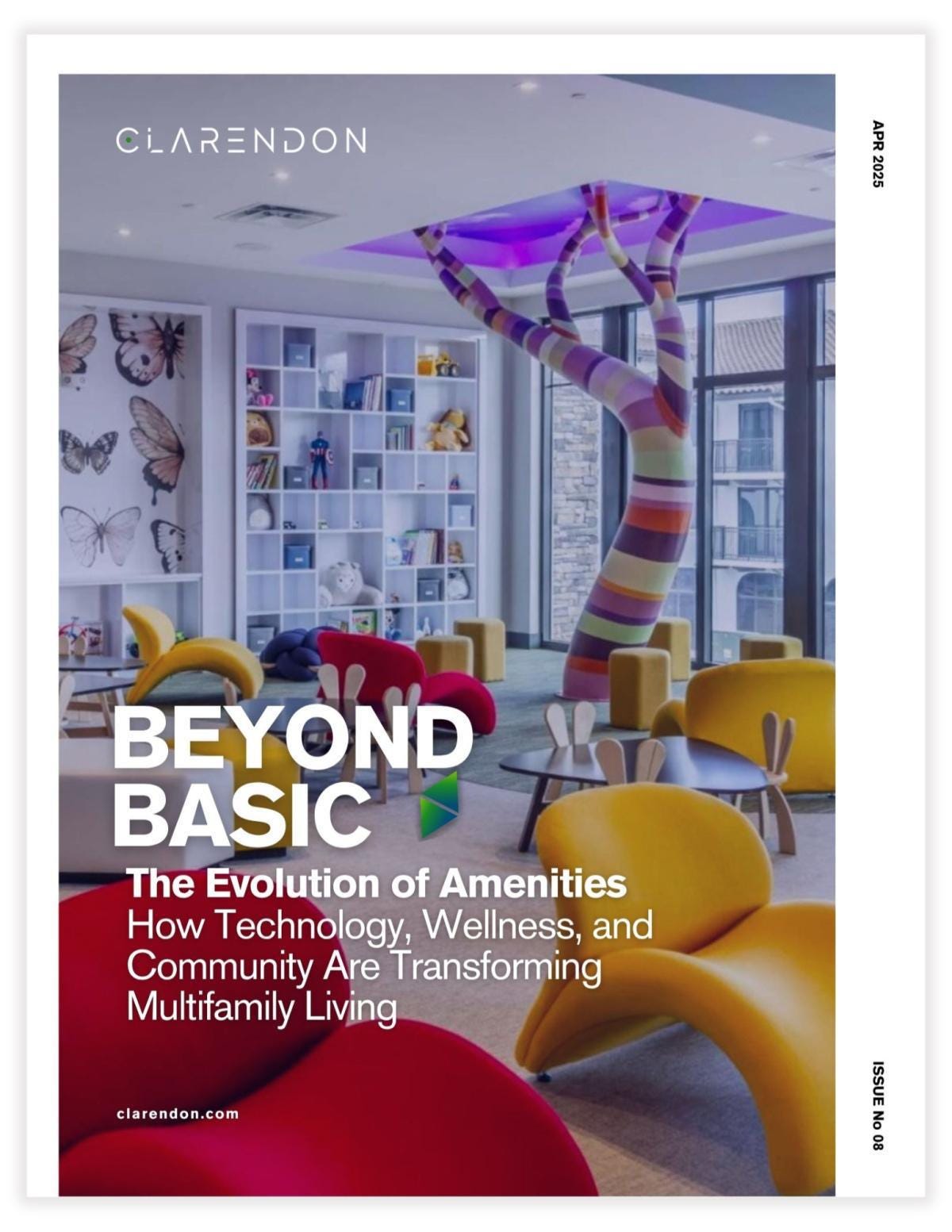
The multifamily amenity has crossed a threshold. High-speed internet is now as essential as running water. Touchless entry, air quality monitoring, and private outdoor space have moved from nice-to-have to expected. What 2020 accelerated was not the creation of new amenity categories — it was the permanent cementing of trends that had already been building for a decade, compressed into a single period of recalibration.
For property owners and operators, this shift creates a strategic question: which amenity investments generate measurable returns, and which are trend-chasing with a short shelf life? According to Greystar’s 2024 By Design Survey, properties with comprehensive amenity packages command rent premiums across all market segments — and the data points to a counterintuitive conclusion. The greatest pricing power is not in the luxury tier. It’s in the middle market.
This brief works through the full picture: how the amenity landscape evolved, what today’s three-pillar model looks like in practice, how demographic differences should shape amenity planning, and what strategic flexibility means for long-term asset performance.
From Conveniences to Lifestyle Infrastructure
The evolution is easier to understand as a progression than as a single shift. A century ago, indoor plumbing was the selling point. By the 1950s, it was community laundry rooms and assigned parking. The 1960s and 1970s introduced recreational perks — pools, clubhouses — marking the beginning of amenity-driven differentiation. Through the 1980s into the early 2000s, resident needs diversified: pet accommodations, fitness centers, business lounges, electronic access, online rent portals.
Each era added layers. What 2020 did was reweight them. Remote work made dedicated workspace a functional necessity rather than a perk. Social distancing elevated private outdoor areas and reduced the appeal of dense shared spaces. Public health awareness accelerated demand for touchless systems and air quality monitoring — features that had existed on the horizon for years but were suddenly urgent.
The result is a market where amenities are no longer evaluated against a baseline of convenience. They’re evaluated against a standard of lifestyle support. Properties that understand this — and invest accordingly — are positioned to outperform on both retention and rent growth.
The Three-Pillar Model
Modern amenity strategy is built around three interrelated pillars. Technology integration, wellness support, and community-building are not independent categories — they reinforce each other, and the most effective amenity packages integrate all three.
Technology as utility. Smart locks, thermostats, and access systems are now expected in new development. Smart leak detection and predictive maintenance tools serve dual roles: they offer operational savings for owners and sustainability credibility with residents. Units with comprehensive tech features consistently command higher rents, though the challenge for operators is maintaining usability across diverse resident age groups and technical skill levels. The goal is an integrated platform — not a collection of disconnected devices — where residents can manage climate, access, and maintenance from a single interface.
Wellness beyond physical fitness. The wellness umbrella has expanded substantially. Biophilic design — rooftop gardens, natural light optimization, living walls — addresses the mental and emotional dimension of well-being that a standard gym does not. Sophisticated fitness centers now share floor space with yoga rooms, saunas, and cold plunge recovery areas. Post-pandemic design incorporates clean air and natural ventilation as design standards, not optional upgrades. Even digital detox zones — quiet spaces explicitly designated as screen-free — are appearing in new projects. Wellness amenities contribute to longer tenancies and higher resident satisfaction, both of which translate directly into measurable property performance outcomes.
Community as amenity. Human connection may be the most underestimated component of the modern amenity package. Lounge areas, rooftop decks, and event-ready communal spaces provide venues for both spontaneous and organized social interaction. Properties that program community events — cooking classes, movie nights, pet socials — transform static spaces into active gathering points. Niche amenities like dog parks and bicycle repair stations serve dual functions: practical utility and social catalyst. Research consistently shows that residents who form relationships within their communities renew at significantly higher rates. The design challenge is cultivating interaction while preserving personal boundaries — a balance that defines the modern communal experience.
Demographic Nuances: One Size Doesn’t Fit All
Amenity preferences vary meaningfully across life stages, and effective planning requires matching the offering to the audience.
Younger renters — Gen Z and Millennials — treat hyper-connectivity and flexibility as baseline requirements. Smart home technology, mobile app-based access, and coworking spaces are not perks for this cohort; they’re decision criteria. Fast, reliable internet ranks near air conditioning in leasing priority.
Families prioritize function and safety. In-unit laundry, secure access, child-friendly spaces, and stroller storage reduce daily friction in ways that rooftop amenities do not. For this segment, the amenity that removes a logistical problem often outweighs the amenity that adds an experience.
The Build-for-Rent sector has formalized this differentiation into its own asset class, blending the privacy of detached homes with shared amenities — walking trails, fitness centers, dog parks — while offering interiors with dedicated office space, large kitchens, private yards, and smart tech customization. Traditional multifamily has responded by enhancing flexibility: acoustically private work pods, enterprise-grade Wi-Fi, and modular community spaces that serve multiple uses across the day.
Senior living has undergone the most substantial transformation. Active, independent lifestyles are now the expectation, not the exception, for this demographic. Wider doorways, step-free entries, and motion-sensor lighting address safety without compromising dignity. Fitness classes, nutrition-focused programming, social clubs, and educational workshops add meaning and social connection to daily life. For this cohort, community infrastructure is as important as physical accessibility.
Strategy Over Trend-Chasing
The amenity decisions with the strongest long-term returns share a common characteristic: they serve multiple functions. A club room that operates as a coworking hub by day and a community lounge by night delivers better return on investment than a single-function space. Outdoor areas designed to accommodate recreation, relaxation, and events stay relevant as resident needs shift. Multi-use design is not a compromise — it’s a hedge against the depreciation of single-purpose spaces.
Balancing universal and targeted offerings is equally important. Secure package lockers, fast internet, and safe access systems have broad appeal across all demographics and building classes. But successful properties also tailor elements for their core audience — pet spas for animal-centric communities, culinary studios for food-oriented residents. Experiences and programming can generate meaningful differentiation without significant infrastructure investment.
Sustainability has moved from optional to directional. Electric vehicle charging stations, solar integration, and water conservation systems are approaching the status of expected features in new development. Operators who install EV infrastructure now are positioning their assets ahead of a demand curve that is still accelerating. The same logic applies to integrated tech platforms: residents increasingly expect a single app for climate control, access management, and maintenance requests rather than separate systems for each function.
Amenity ROI: What the Data Shows
The performance premium for well-amenitized properties is measurable — and the pattern is more nuanced than expected. According to Greystar’s 2024 By Design Survey, features like keyless smart locks, controlled access, and fitness centers command rent premiums ranging from 50 to 77 dollars per month across all building classes.
The most significant finding is the relative pricing power by tier. In the technology integration category, four- and five-star luxury properties see a premium of 249 dollars per month for comprehensive tech packages; three-star mid-tier properties see 184 dollars; one- and two-star affordable properties see 200 dollars. In the wellness category, the premium is 255 dollars per month at the luxury tier, 191 dollars at mid-tier, and 196 dollars at the affordable tier. In community programming, luxury properties command 236 dollars; mid-tier 164 dollars; affordable 179 dollars.
The implication is clear: one- and two-star assets often command a higher amenity premium relative to their rent base than luxury properties, where these features are already baseline expectations. Targeted, cost-effective amenity upgrades in middle-market and affordable assets can yield significant returns in both rent growth and resident satisfaction — making amenity strategy one of the more accessible levers for property performance enhancement across the portfolio.
Ready to go deeper? Clarendon provides HUD Rent Comparability Studies, market studies, brokerage, and advisory services across major U.S. markets. To discuss your portfolio, visit clarendon.com/how-can-we-help
What’s in the Full Brief

The MarketRent™ Beyond Basic brief covers the full evolution of multifamily amenities — from basic utilities to lifestyle infrastructure — including the three-pillar model of technology integration, wellness support, and community-building, a generational breakdown of demographic amenity preferences, strategic guidance on multi-use design and long-term value planning, and the Amenity ROI metrics section with rent premium data by amenity category and building class, sourced from Greystar’s 2024 By Design Survey.
The full brief is available to MarketRent™ members at marketrent.us.
Access the Beyond Basic Brief → www.marketrent.us
Related Resources
For more on multifamily market performance and property strategy, see NYC Financial District: A New Era for Downtown Manhattan, Pittsburgh: The Golden Triangle Converts, Cleveland: Urban Revival and the Adaptive Reuse Opportunity, and Mapping the Shift: Where Offices Are Becoming Homes.


Podcast • Tools • Services • Archive • About • Contact
About: Clarendon is a trusted partner for government compliance and advisory solutions, specializing in HUD-compliant services: HUD RCS, appraisals, brokerage, inspections, facility support and strategic guidance for agencies, housing authorities and property owners nationwide.
© 2026 The Clarendon Group, Inc. All Rights Reserved. Disclosure