



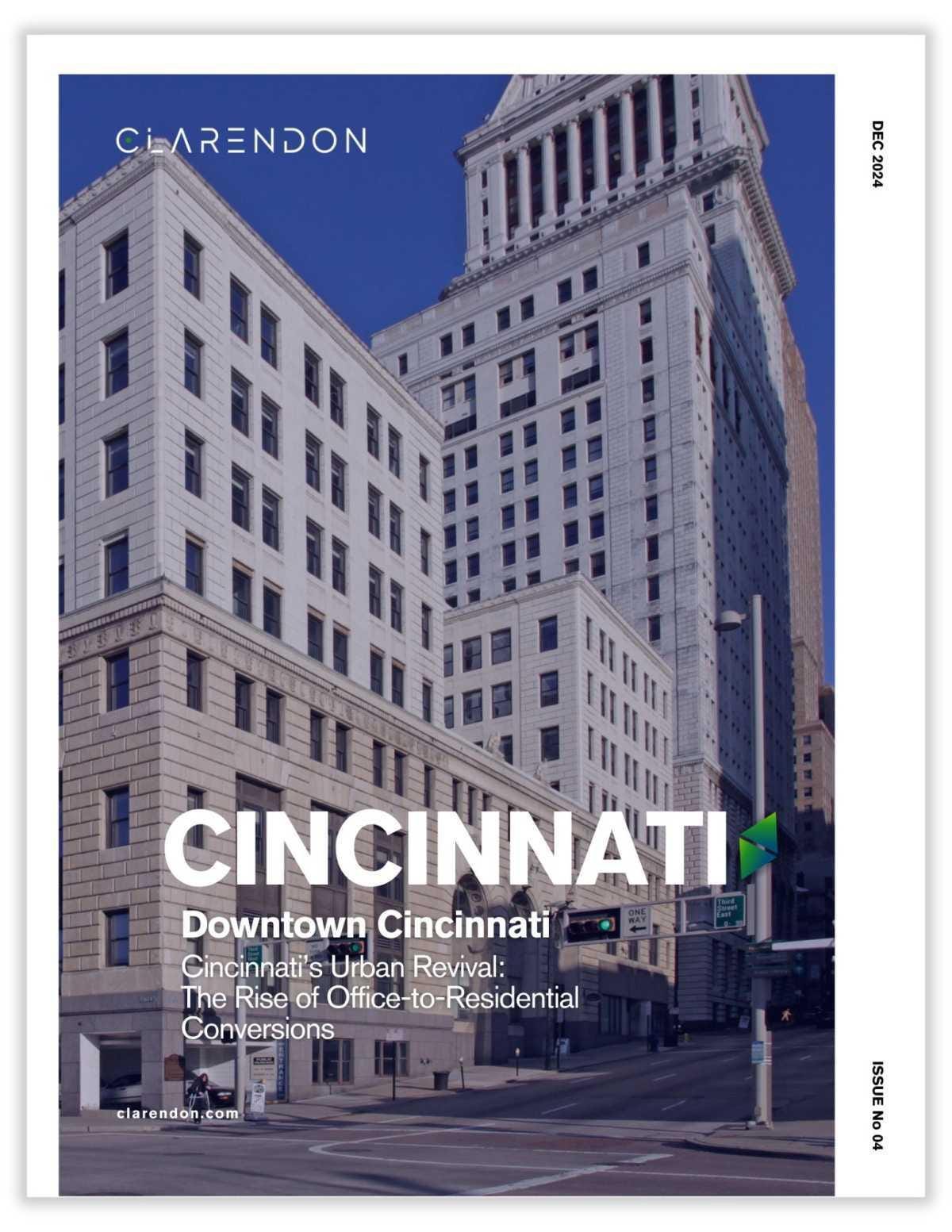
Cincinnati has quietly become one of the more active office-to-residential conversion markets in the Midwest. While post-pandemic adaptive reuse has become a national narrative, Cincinnati’s approach is rooted in something more durable: a deep inventory of historic architecture, a set of state-level financial incentive programs that make conversions financially viable, and a downtown that is drawing young professionals and empty-nesters in search of urban living options at a meaningful affordability discount to coastal markets.
Year-to-date rent growth in the Cincinnati Metro stands at 2.6% — nearly three times the national average of 0.9% — with growth projected to reach 5.3% by 2025 as construction moderates and demand stabilizes, according to CoStar. Average metro rents of 1,272 dollars per month position Cincinnati as one of the more accessible urban multifamily markets among the nine cities in this series.
The conversion pipeline is deepening. From landmark Beaux Arts towers to former corporate headquarters, Downtown Cincinnati’s building stock is being repositioned into modern, mixed-use residential communities that preserve historic character while meeting contemporary housing demand.
The Flagship Conversion
309 Vine Street — a 325,200 square foot Beaux Arts building constructed in 1927 — has been transformed into a mixed-use development featuring 294 luxury apartments, including micro-apartments and penthouses, alongside a ground-floor market, a rooftop restaurant, Class A office space, and a 330-car garage. Developed by The Union Central Life Insurance Company at a cost of 75 million dollars, the project was completed in 2018 and introduced a range of urban living formats not previously available in the Greater Cincinnati market.
The pipeline extends well beyond this anchor project. At 205 West Fourth Street, the former Textile Building — a 215,000 square foot 12-story office structure built in 1906 — was converted by Bernstein Companies into 282 market-rate apartments at a cost of 70 million dollars, completed in 2023, with rooftop lounge, coworking spaces, a gym, and pickleball and golf simulators. At 580 Walnut Street, the 290,000 square foot AT580 building was repositioned by Birkla Investment Group into 179 residential units including two-story penthouse suites with private elevators, completed in 2017 for 40 million dollars. At 7 West 7th Street, the former Macy’s corporate headquarters is being converted into 341 residential units across 14 floors by Victrix LLC, with completion expected by end of 2025 for 73 million dollars.
Why Now
Ohio’s financial incentive framework has been essential to Cincinnati’s conversion activity. The Ohio State Historic Preservation Tax Credit program, the Transformational Mixed-Use Development program, and the Ohio Brownfield Remediation Program have collectively enabled projects that would otherwise face prohibitive financial gaps. By providing tax credits, remediation funds, and structural improvement incentives, these programs have unlocked buildings that sat underutilized for years and transformed them into contributors to the city’s residential base.
Cincinnati’s employment market provides the demand foundation for this supply. Employment grew 3.3% year-over-year as of mid-2023, outpacing the national average of 2.2%. Leisure and hospitality added 16,000 jobs — a 12% increase — driven by strong tourism. Manufacturing accounts for 10.4% of employment with notable aerospace sector gains. The unemployment rate of 4.0% reflects a broadly healthy labor market, and sustained hiring across healthcare and manufacturing supports multifamily demand particularly in the downtown core, where the conversion pipeline is creating new inventory for renters seeking urban living with access to amenities and jobs.
The Multifamily Metrics
Cincinnati Metro rent growth of 2.6% year-to-date leads the national average of 0.9% by a substantial margin, according to CoStar. One- and two-star affordable units post the strongest growth at 3.2%, averaging 924 dollars per month. Three-star mid-tier properties follow at 3.0% growth with average rents of 1,294 dollars per month — highly sought after for their balance of quality and affordability. Four- and five-star luxury units recorded 1.5% growth at 1,762 dollars per month, with ongoing pressure from vacancy in recently delivered product.
In Downtown Cincinnati, rent growth reached 2.1% year-to-date, slightly below the metro average but meaningfully above national benchmarks. Four- and five-star effective rents stand at 1,906 dollars per month, with 1.1% growth. Three-star units recorded 2.4% growth at 1,293 dollars per month. One- and two-star units led downtown rent growth at 3.6%, averaging 934 dollars per month — reflecting persistent demand for affordable downtown options.
Cincinnati Metro vacancy of 6.9% sits below the national average of 7.9%, reflecting the region’s relative market stability and noncyclical employment base. Four- and five-star vacancy stands at 8.5%, with steady new deliveries contributing to elevated rates in the luxury segment. Three-star vacancy of 6.8% and one- and two-star vacancy of 6.2% reflect more balanced supply-demand dynamics across these segments. Downtown vacancy of 9.6% reflects elevated deliveries including projects like the Artistry Cincy and the Textile Building conversion, and is projected to rise modestly to 10.4% by 2025 before stabilizing as the supply cycle matures.
Cincinnati Metro construction activity of 4.43% of inventory slightly exceeds the national average of 3.51%, with 3,388 units completed year-to-date — a 15% decline from 2023. Downtown mirrors the metro at 4.58% of inventory under construction, with activity concentrated in luxury and mixed-use projects. The moderating pace of deliveries positions the market for improved absorption as the pipeline normalizes.
Ready to go deeper on this market? Clarendon provides HUD Rent Comparability Studies, market studies, brokerage, and advisory services across major U.S. markets. To discuss your portfolio, visit clarendon.com/how-can-we-help
Explore the Conversion Projects
MarketRent™ tracks office-to-residential conversion projects across nine major U.S. cities. The interactive map includes individual property profiles with developer, unit count, construction status, and development cost for each project.
Explore the Interactive Conversion Map — Cincinnati and 8 Cities
Members can access the full interactive map at marketrent.us — search and filter projects across Cincinnati, Cleveland, New York, Boston, Detroit, Pittsburgh, Philadelphia, Washington DC, and Los Angeles.
What’s in the Full Market Brief

The MarketRent™ Market Brief on Cincinnati covers the office-to-residential conversion projects reshaping Downtown — with individual property profiles including developer, unit count, construction status, and development cost — alongside rent growth and vacancy rate analysis across the US, Cincinnati Metro, and Downtown Cincinnati submarket, new supply and absorption data, and a review of the economic drivers shaping the Cincinnati market, including Ohio’s financial incentive programs and the city’s employment base.
The full brief is available to MarketRent™ members at marketrent.us.
Access the Cincinnati Market Brief → www.marketrent.us
Related Resources
For more on office-to-residential conversion trends across U.S. markets, see NYC Financial District: A New Era for Downtown Manhattan, Pittsburgh: The Golden Triangle Converts, Cleveland: Urban Revival and the Adaptive Reuse Opportunity, and Mapping the Shift: Where Offices Are Becoming Homes.


Podcast • Tools • Services • Archive • About • Contact
About: Clarendon is a trusted partner for government compliance and advisory solutions, specializing in HUD-compliant services: HUD RCS, appraisals, brokerage, inspections, facility support and strategic guidance for agencies, housing authorities and property owners nationwide.
© 2026 The Clarendon Group, Inc. All Rights Reserved. Disclosure
