



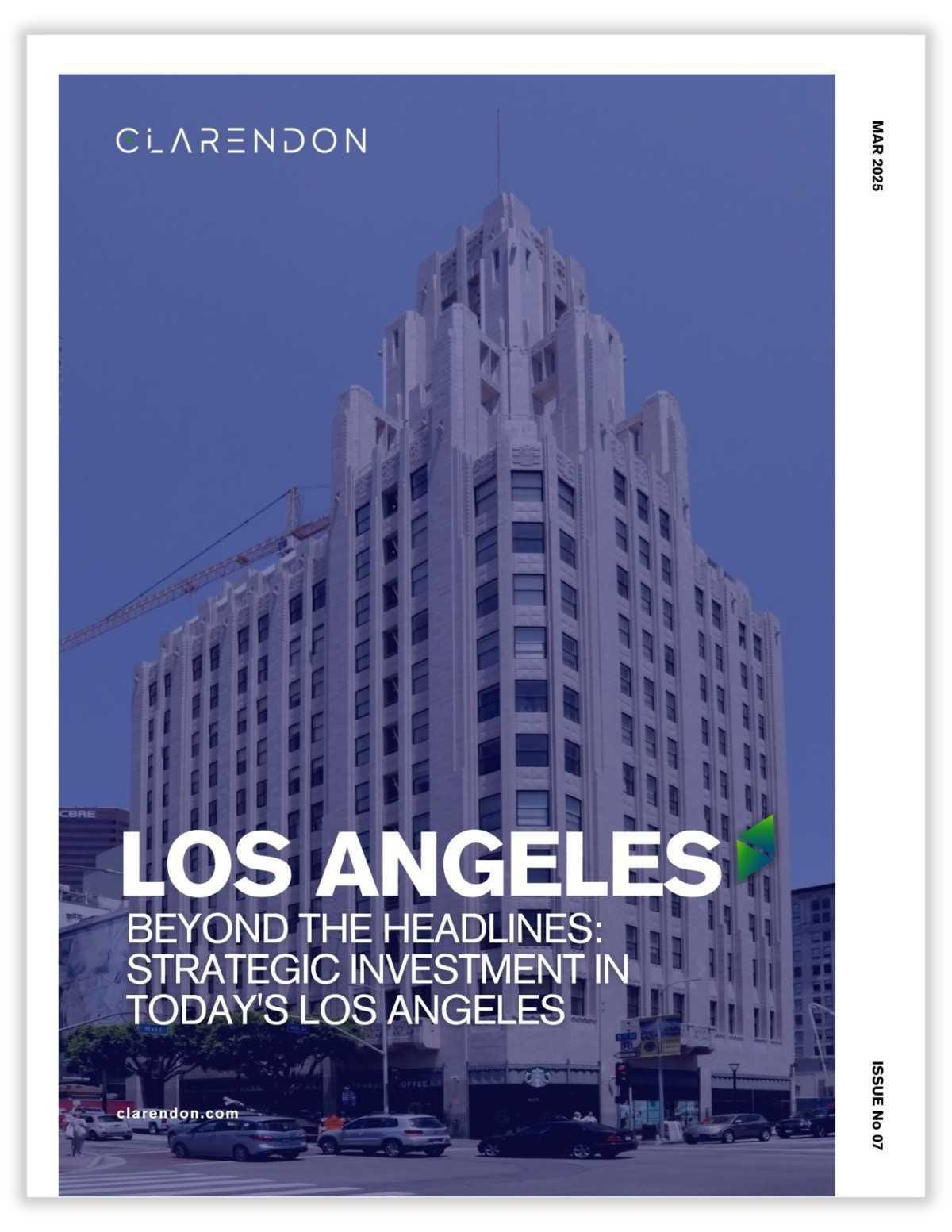
Los Angeles ranks 14th in the 2025 Resonance Best World Cities report, and the city is entering what its boosters are calling a Decade of Sport — hosting the 2026 FIFA World Cup and the 2028 Olympics and Paralympics, making it the first U.S. city to host the Summer Games three times. Major infrastructure investments and cultural commitments are accelerating alongside those events.
The multifamily investment landscape in Los Angeles, however, has undergone a genuine recalibration. Los Angeles County’s share of U.S. apartment investment has declined from 5.4% in the 2010s to 3.7% in the 2020s, according to MSCI Real Capital Analytics. New apartment construction accounted for only 1.1% of newly built units nationwide in 2024 — the lowest share in more than 25 years. A three-year COVID-era eviction ban, a 5.5% transfer tax on apartment sales, and more recently a wildfire-related county-wide eviction ban allowing renter self-certification have introduced layers of regulatory complexity not present in neighboring Orange County or San Diego.
Understanding this market now requires differentiating between submarkets. Downtown LA and South LA are operating under meaningfully different supply, demand, and rent dynamics — and both are evolving.
The Flagship Conversion
1055 West 7th Street — a 32-story, 961,271 square foot office tower built in 1987 — is planned for conversion into 686 residential units by Jamison Properties. The project will retain the building’s floor-to-ceiling windows and panoramic views while repurposing existing mechanical, electrical, and plumbing systems. Planned amenities include a fitness center, coworking space, theater, golf simulator, karaoke room, and card room. The conversion represents one of the largest adaptive reuse projects in DTLA’s current pipeline.
The broader Downtown conversion portfolio reflects decades of adaptive reuse activity. At 354 Spring Street, the former HWH building — a 143,902 square foot structure built in 1903 — was converted into 188 residential units by Neighborhood Effort, completed in 2020, restoring original stained glass domed skylights, marble corridors, and maple hardwood floors alongside 17,500 square feet of ground-floor retail. At 939 South Broadway, the historic Western Costume Building was converted into 939 Lofts, a 151-unit condominium development with rooftop amenities, completed in 2019. At 430 South Broadway, the 1906 Bumiller/Campbell Blake Building was converted into 58 live-work lofts as Broadway Lofts, completed in 2015.
Why Now
Downtown LA’s adaptive reuse history runs deep. The 1999 Adaptive Reuse Ordinance facilitated the conversion of historic office buildings into residential units, and between 1999 and 2008 these projects accounted for 87% of new residential inventory in the area. The recently approved Downtown Community Plan — known as DTLA 2040 — expands these opportunities by allowing conversions of buildings older than 25 years, broadening the potential housing supply and creating a policy framework for continued investment despite the broader regulatory environment.
Downtown currently comprises roughly 55,000 residential units with an additional 27,000 in the pipeline. Market-rate rentals and condos account for 38,000 of the existing units. Occupancy rates for established properties have consistently remained above 90%, indicating sustained underlying demand even as new supply faces lease-up headwinds.
South Los Angeles offers a different entry point. Since 2015, the submarket has transformed from an overlooked district into a recognized multifamily investment destination. The Metro K Line, partially opened in 2022, has reshaped development patterns, with transit-oriented incentives driving housing near key stations. USC’s 700 million dollar Village complex, completed in 2017, has strengthened its surrounding market. BMO Stadium has energized the Exposition Park district. The Lucas Museum of Narrative Art, expected to open in 2026, will further enhance neighborhood desirability. South LA vacancy stands at 2.8% — among the tightest in the metro — with virtually no new construction activity, creating conditions of constrained supply that support continued rent performance.
The Multifamily Metrics
Los Angeles Metro year-to-date rent growth stands at 0.8%, reflecting the market’s complexity: outmigration, affordability constraints, and the lingering effects of pandemic-era rent collection challenges, according to CoStar. Average rents across the metro are 2,803 dollars per month in Downtown and considerably lower across broader submarkets. Mid-tier three-star properties lead metro growth at 1.1%, reaching 2,417 dollars per month. Four- and five-star luxury units posted 0.5% growth, averaging 3,318 dollars per month. One- and two-star affordable units grew by 1.0%, averaging 1,799 dollars per month.
In Downtown Los Angeles, market rents declined negative 0.5% year-to-date, with the four- and five-star segment also at negative 0.5% and mid-tier units at negative 1.0%. New supply continues to put downward pressure on rents as established inventory competes with newly delivered product.
South Los Angeles presents a starkly different performance profile, with overall rent growth of 2.3% year-to-date. Three-star properties led at 3.7% growth. One- and two-star affordable units grew 2.2%. The submarket’s affordability relative to the rest of Los Angeles continues to sustain consistent renter demand.
Metro LA vacancy of 4.8% year-to-date sits significantly below the national average of 8.1%, reflecting the structural supply constraints that define this market across most submarkets. Downtown LA vacancy stands at 10.6%, with four- and five-star units at 11.2%. South LA maintains 2.8% vacancy — one of the tightest multifamily submarkets in the country. Metro construction pipeline of 1.92% of inventory year-to-date is well below the national average of 3.23%, down from a 2.62% peak in 2023, as regulatory complexity and construction costs restrain new development.
Ready to go deeper on this market? Clarendon provides HUD Rent Comparability Studies, market studies, brokerage, and advisory services across major U.S. markets. To discuss your portfolio, visit clarendon.com/how-can-we-help
Explore the Conversion Projects
MarketRent™ tracks office-to-residential conversion projects across nine major U.S. cities. The interactive map includes individual property profiles with developer, unit count, construction status, and development cost for each project.
Explore the Interactive Conversion Map — Los Angeles and 8 Cities
Members can access the full interactive map at marketrent.us — search and filter projects across Los Angeles, New York, Boston, Cleveland, Detroit, Pittsburgh, Philadelphia, Washington DC, and Cincinnati.
What’s in the Full Market Brief

The MarketRent™ Market Brief on Los Angeles covers the office-to-residential conversion projects shaping Downtown LA — with individual property profiles including developer, unit count, construction status, and development cost — alongside rent growth and vacancy rate analysis across the US, Los Angeles Metro, Downtown LA, and South Los Angeles submarkets, new supply and absorption data, and a review of the economic and regulatory drivers shaping the Los Angeles market, including DTLA 2040 and the South LA investment landscape.
The full brief is available to MarketRent™ members at marketrent.us.
Access the Los Angeles Market Brief → www.marketrent.us
Related Resources
For more on office-to-residential conversion trends across U.S. markets, see NYC Financial District: A New Era for Downtown Manhattan, Pittsburgh: The Golden Triangle Converts, Cleveland: Urban Revival and the Adaptive Reuse Opportunity, and Mapping the Shift: Where Offices Are Becoming Homes.

Podcast • Tools • Services • Archive • About • Contact
About: Clarendon is a trusted partner for government compliance and advisory solutions, specializing in HUD-compliant services: HUD RCS, appraisals, brokerage, inspections, facility support and strategic guidance for agencies, housing authorities and property owners nationwide.
© 2026 The Clarendon Group, Inc. All Rights Reserved. Disclosure
