



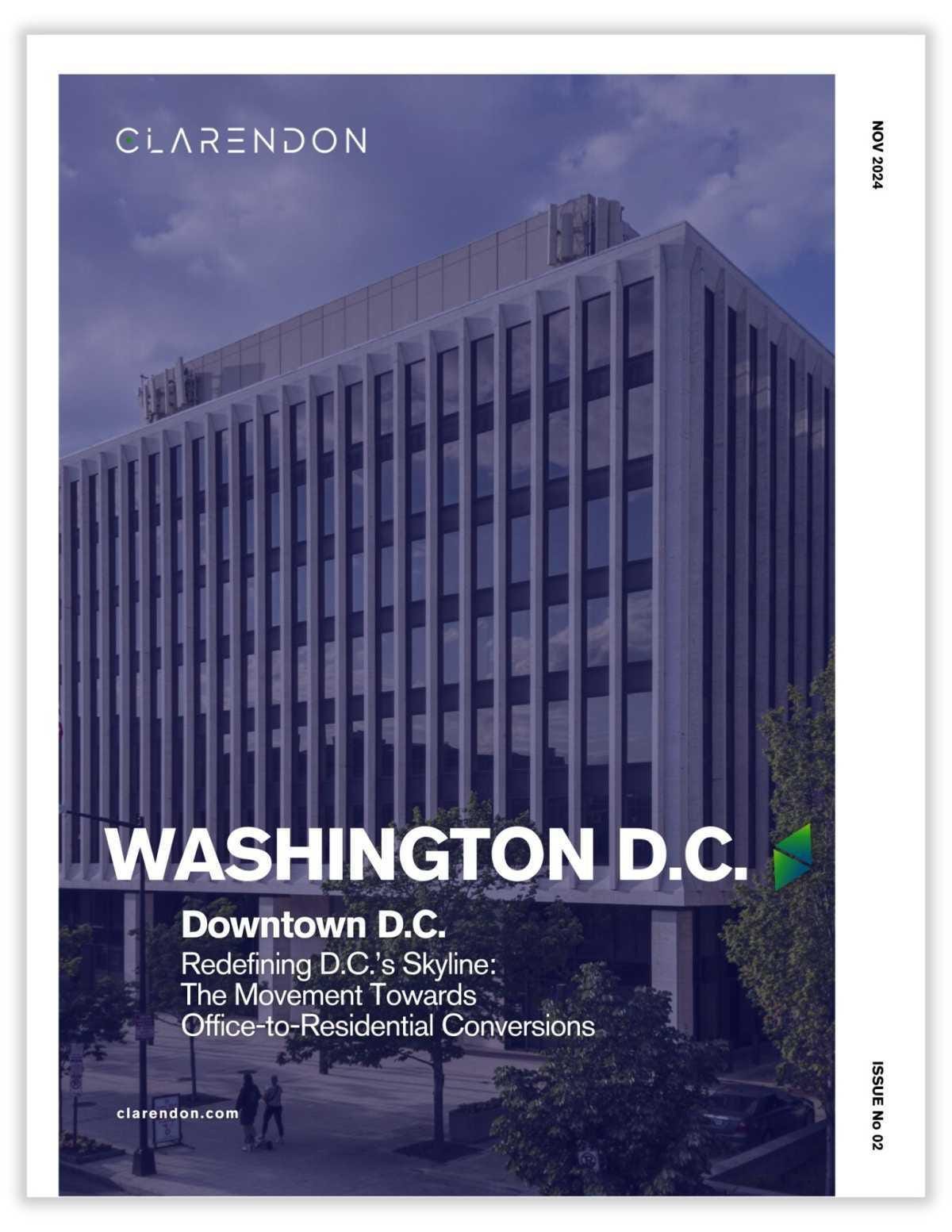
Washington D.C. is executing one of the most policy-driven office-to-residential conversion programs in the country. The District’s Housing in Downtown initiative — targeting 15,000 new residents in the downtown area by 2028 — offers 20-year property tax abatements, regulatory exemptions, and affordable housing requirements that collectively make otherwise financially marginal conversions viable. The program reflects a recognition that Downtown D.C.’s office market faces a structural, not cyclical, vacancy challenge, and that diversifying the submarket’s use base is the most durable path to long-term stability.
Year-to-date rent growth in the Washington D.C. Metro stands at 2.8% — more than three times the national average of 0.9% — sustained by population growth and a stable, diversified employment base, according to CoStar. Metro vacancy of 6.9% sits below the national average of 7.9%, with absorption closely matching new deliveries and creating conditions for continued stabilization.
D.C.’s conversion story is one of a city with institutional depth — federal government, technology, healthcare, professional services — leveraging that foundation to repurpose its most underutilized asset: a downtown office market that was losing ground before the pandemic and has not recovered at the pace seen in other major metros.
The Flagship Conversion
1425 New York Avenue NW — a 13-story, 287,042 square foot structure near the White House — is being converted by Foulger-Pratt Companies into Accolade, a 255-unit Class A-plus luxury residential property. Upon completion, it will be the nearest residential building to the White House. The project exemplifies the ambition of the Housing in Downtown program: repositioning prime commercial real estate at the geographic core of the district into high-quality residential inventory.
The completed and active pipeline spans a range of scales and approaches. At 1111 20th Street, the former Peace Corps building — a 186,012 square foot structure built in 1963 — was converted by Willco into 163 market-rate apartments with a rooftop pool, fitness center, coworking areas, and a dog park, completed in 2024. At 1625 Massachusetts Avenue NW, a 119,000 square foot former Air Line Pilots Association headquarters at Scott Circle is being converted by National Real Estate Development into 157 residential units at a cost of 65 million dollars, prioritizing structural retention for sustainability. At 2501 M Street NW, a 100,000 square foot former Association of American Medical Colleges headquarters in the West End was converted by PRP Real Estate into 60 luxury condominiums with an 11,475 square foot Nobu restaurant on the ground floor, completed in 2018. At 1201 L Street NW, a 36,000 square foot building is planned for expansion to 133,000 square feet and conversion into 145 affordable units for residents earning 30% to 80% of area median income, with 99-year affordability preservation, expected completion in 2026.
Why Now
D.C.’s office market vacancy challenge predates the pandemic. Remote and hybrid work accelerated what was already a structural shift — and the relocation of 2,500 FBI jobs to Maryland has added a more recent headwind to downtown office demand. The Housing in Downtown program addresses this directly: by making residential conversion financially feasible and requiring affordable units, the program creates a pathway to a more resilient, mixed-use downtown core.
The broader D.C. Metro economy provides the demand foundation. The region added 34,000 jobs over the past year — a 1.0% annual growth rate — with gains concentrated in technology, healthcare, and professional services. The unemployment rate of 2.8% is significantly below the national average of 3.9%, reflecting the region’s structurally strong labor market. Federal government employment remains a stabilizing anchor. Office-using employment grew by just 0.4% year-to-date, consistent with hybrid work patterns, but this modest growth still represents net positive demand against a tight housing market.
The Multifamily Metrics
Washington D.C. Metro rent growth of 2.8% year-to-date reflects steady demand across all building classes, according to CoStar. Three-star mid-tier properties outperformed the market at 3.2% growth with average rents of 1,952 dollars per month, reflecting strong interest from renters seeking quality without top-tier pricing. Four- and five-star luxury units posted 2.4% growth with average rents of 2,636 dollars per month and vacancy of 8.3%, where new supply has sustained elevated rates but demand remains steady. One- and two-star affordable units grew 2.0% to average rents of 1,630 dollars per month, supported by consistent demand for cost-effective options in a high-cost metro.
In Downtown D.C. specifically, rent growth of 1.7% year-to-date reflects the competitive conditions created by elevated vacancy and ongoing conversion deliveries. Four- and five-star properties posted 2.2% growth. Three-star units grew 0.8%. One- and two-star units grew 1.8%. Downtown vacancy of 7.7% is led by luxury units at 9.3%, with mid-tier properties at 5.2% performing considerably more steadily. The Housing in Downtown program projects Downtown vacancy to reach 6.4% by 2025 as leasing momentum builds and conversion completions add absorbed inventory.
D.C. Metro construction activity of 4.1% of inventory — approximately 23,500 units under construction — exceeds the national average of 3.51%, reflecting the metro’s sustained developer confidence despite broader market caution. Construction has slowed 35% year-over-year as financing conditions have tightened, which is helping to moderate the pace of new deliveries and support absorption. In Downtown, 3.1% of inventory is under construction, with activity primarily driven by office-to-residential conversions including 1625 Massachusetts Avenue and The Geneva at 600 units, all benefiting from the Housing in Downtown tax abatement program.
Ready to go deeper on this market? Clarendon provides HUD Rent Comparability Studies, market studies, brokerage, and advisory services across major U.S. markets. To discuss your portfolio, visit clarendon.com/how-can-we-help
Explore the Conversion Projects
MarketRent™ tracks office-to-residential conversion projects across nine major U.S. cities. The interactive map includes individual property profiles with developer, unit count, construction status, and development cost for each project.
Explore the Interactive Conversion Map — Washington DC and 8 Cities
Members can access the full interactive map at marketrent.us — search and filter projects across Washington DC, New York, Boston, Cleveland, Detroit, Pittsburgh, Philadelphia, Los Angeles, and Cincinnati.
What’s in the Full Market Brief

The MarketRent™ Market Brief on Washington DC covers the office-to-residential conversion projects reshaping Downtown D.C. — with individual property profiles including developer, unit count, construction status, and development cost — alongside rent growth and vacancy rate analysis across the US, Washington D.C. Metro, and Downtown D.C. submarket, new supply and absorption data, and a review of the economic drivers shaping the D.C. market, including the Housing in Downtown program and the metro’s diversified employment base.
The full brief is available to MarketRent™ members at marketrent.us.
Access the Washington DC Market Brief → www.marketrent.us
Related Resources
For more on office-to-residential conversion trends across U.S. markets, see NYC Financial District: A New Era for Downtown Manhattan, Pittsburgh: The Golden Triangle Converts, Cleveland: Urban Revival and the Adaptive Reuse Opportunity, and Mapping the Shift: Where Offices Are Becoming Homes.


Podcast • Tools • Services • Archive • About • Contact
About: Clarendon is a trusted partner for government compliance and advisory solutions, specializing in HUD-compliant services: HUD RCS, appraisals, brokerage, inspections, facility support and strategic guidance for agencies, housing authorities and property owners nationwide.
© 2026 The Clarendon Group, Inc. All Rights Reserved. Disclosure
